
Deep Purple
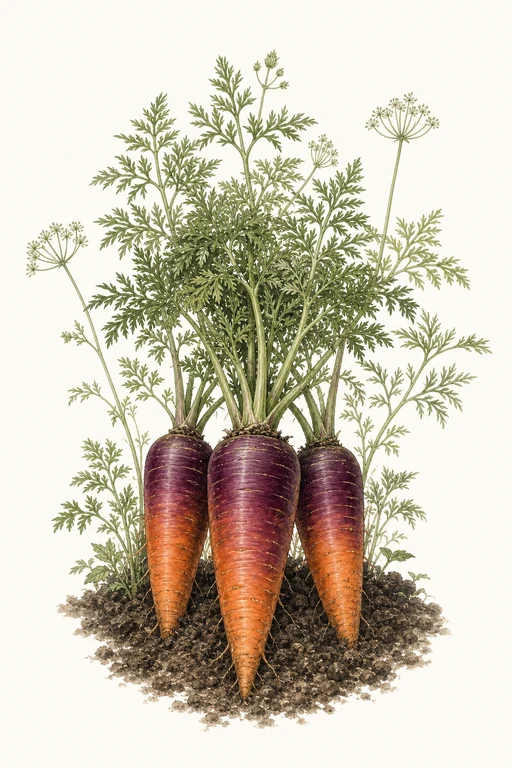
Velvety, inky purple shoulders fade to a warm, crisp orange core—Deep Purple Danvers Carrot delivers a striking color contrast that looks as good as it tastes.
Expect a sweet, earthy flavor with a fine-grained crunch and a tender bite that holds up beautifully after roasting or steaming, and shines fresh for snacking, salads, and vibrant pickles. A classic Danvers silhouette—long, tapered, and dependable—makes this an elegant garden favorite from sowing to harvest.
Light: Full SunMaturity: 75 DaysHabit: Taproot
Location not set yet
Location not set yet
Enter your ZIP for local crop dates
Deep Purple Planting Dates by USDA Zone
Estimated US hardiness-zone windows for sow, transplant, and harvest. Enter a US ZIP above for exact local dates, or open a zone below.
| Zone | Start Indoors | Sow / Transplant | Harvest |
|---|---|---|---|
| Zone 1a | Protected Environment Only | ||
| Zone 1b | Protected Environment Only | ||
| Zone 2a | Direct Sow | May 25th | Aug 8th – Aug 29th |
| Zone 2b | Direct Sow | May 15th | Jul 29th – Aug 25th |
| Zone 3a | Direct Sow | May 15th | Jul 29th – Sep 1st |
| Zone 3b | Direct Sow | May 19th | Aug 2nd – Sep 21st |
| Zone 4a | Direct Sow | May 15th | Jul 29th – Sep 24th |
| Zone 4b | Direct Sow | May 13th | Jul 27th – Sep 27th |
| Zone 5a | Direct Sow | May 8th | Jul 22nd – Sep 30th |
| Zone 5b | Direct Sow | May 4th | Jul 18th – Oct 5th |
| Zone 6a | Direct Sow | May 1st | Jul 15th – Oct 10th |
| Zone 6b | Direct Sow | Apr 25th | Jul 9th – Oct 16th |
| Zone 7a | Direct Sow | Apr 20th | Jul 4th – Oct 20th |
| Zone 7b | Direct Sow | Apr 10th | Jun 24th – Oct 28th |
| Zone 8a | Direct Sow | Apr 1st | Jun 15th – Nov 5th |
| Zone 8b | Direct Sow | Mar 23rd | Jun 6th – Nov 12th |
| Zone 9a | Direct Sow | Mar 6th | May 20th – Nov 26th |
| Zone 9b | Direct Sow | Feb 9th | Apr 25th – Dec 9th |
| Zone 10a | — | Oct 1st | Dec 15th – Feb 28th |
| Zone 10b | — | Oct 1st | Dec 15th – Feb 28th |
| Zone 11a | — | Oct 1st | Dec 15th – Feb 28th |
| Zone 11b | — | Oct 1st | Dec 15th – Feb 28th |
| Zone 12a | — | Oct 1st | Dec 15th – Feb 28th |
| Zone 12b | — | Oct 1st | Dec 15th – Feb 28th |
| Zone 13a | — | Oct 1st | Dec 15th – Feb 28th |
| Zone 13b | — | Oct 1st | Dec 15th – Feb 28th |
Crop Details
| Trait | Value |
|---|---|
| Days to Maturity | 75 |
| Sun Requirements | Full Sun |
| Growth Habit | Taproot |
| Support Needed | None |
| Planting Depth | Normal |
| Germination Temp (°F) | 55 |
| Min Soil Temp (°F) | 45 |
| Min Night Temp (°F) | 28 |
| Harden Off (days) | Not Required |
Culinary Notes

Chef's Note
Deep Purple Danvers holds onto a tender, fine-grained snap even when cooked, with that orange core turning warm and roasty instead of going bland or hollow. Use it where you want crunch and color to survive—roast hard or pickle fast—so every bite lands sweet, earthy, and bright rather than soft.

Best Uses
- sheet-pan roasting until caramelized at the edges
- steamed and glazed with butter or honey for a clean bite
- fresh slicing into salads for high-contrast crunch
- quick-pickling for crisp, vivid magenta-red shoulders

Flavor Profile

Kitchen Pairings
Frequently Asked Questions
What pest or disease commonly affects Daucus carota (carrot) and how do I manage it at home?
How often should I water Deep Purple carrots during the main growing phase?
How can I tell when Deep Purple carrots are ready to harvest?
Sowing Tips

Transplant Conditions
Wait until soil reaches 45°F and nights stay above 28°F before moving outdoors.
Expert Note

Direct-sow seeds in well-loosened, stone-free soil so the roots can form straight and uniform; keep the bed evenly moist until emergence.