
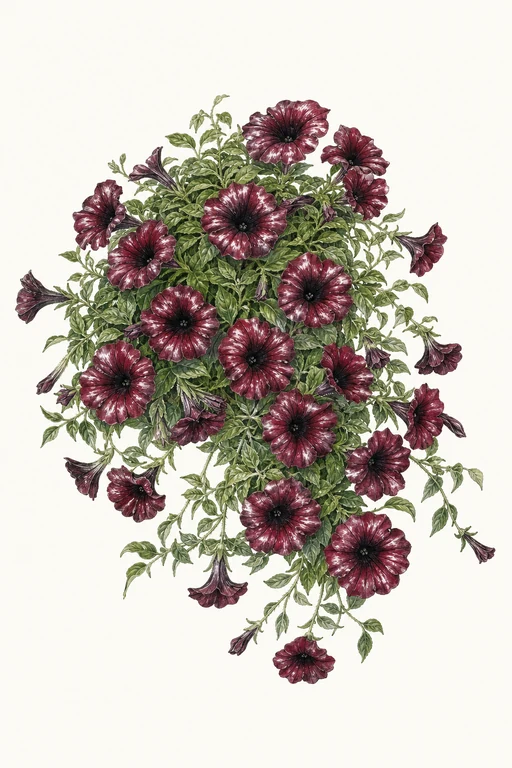
Ramblin' Burgundy Chrome
Velvety petals unfurl in a mesmerizing chrome-sheen of burgundy and plum, with a softly glowing center that seems to catch the light at every turn.
Ramblin' Burgundy Chrome spreads with a trailing, cascading habit, producing a steady ribbon of blooms that feel plush to the eye—dense, rounded, and richly saturated from edge to edge. Grow it for nonstop color in hanging baskets, window boxes, and garden drifts, where its trailing cascade becomes a living tapestry of deep wine tones all season long.
Light: Full SunMaturity: 70 DaysHabit: Spreading
Location not set yet
Location not set yet
Enter your ZIP for local crop dates
Ramblin' Burgundy Chrome Planting Dates by USDA Zone
Estimated US hardiness-zone windows for sow, transplant, and harvest. Enter a US ZIP above for exact local dates, or open a zone below.
| Zone | Start Indoors | Sow / Transplant | Harvest |
|---|---|---|---|
| Zone 1a | Protected Environment Only | ||
| Zone 1b | Protected Environment Only | ||
| Zone 2a | Direct Sow | Jul 20th | Sep 28th – Aug 29th |
| Zone 2b | Direct Sow | Jul 10th | Sep 18th – Aug 25th |
| Zone 3a | Direct Sow | Jul 10th | Sep 18th – Sep 1st |
| Zone 3b | Direct Sow | Jul 14th | Sep 22nd – Sep 21st |
| Zone 4a | Direct Sow | Jul 10th | Sep 18th – Sep 24th |
| Zone 4b | Direct Sow | Jul 8th | Sep 16th – Sep 27th |
| Zone 5a | Direct Sow | Jul 3rd | Sep 11th – Sep 30th |
| Zone 5b | Direct Sow | Jun 29th | Sep 7th – Oct 5th |
| Zone 6a | Direct Sow | Jun 26th | Sep 4th – Oct 10th |
| Zone 6b | Direct Sow | Jun 20th | Aug 29th – Oct 16th |
| Zone 7a | Direct Sow | Jun 15th | Aug 24th – Oct 20th |
| Zone 7b | Direct Sow | Jun 5th | Aug 14th – Oct 28th |
| Zone 8a | Direct Sow | May 27th | Aug 5th – Nov 5th |
| Zone 8b | Direct Sow | May 18th | Jul 27th – Nov 12th |
| Zone 9a | Direct Sow | May 1st | Jul 10th – Nov 26th |
| Zone 9b | Direct Sow | Apr 6th | Jun 15th – Dec 9th |
| Zone 10a | Continuous Production | ||
| Zone 10b | Continuous Production | ||
| Zone 11a | Continuous Production | ||
| Zone 11b | Continuous Production | ||
| Zone 12a | Continuous Production | ||
| Zone 12b | Continuous Production | ||
| Zone 13a | Continuous Production | ||
| Zone 13b | Continuous Production | ||
Crop Details
| Trait | Value |
|---|---|
| Days to Maturity | 70 |
| Sun Requirements | Full Sun |
| Growth Habit | Spreading |
| Support Needed | None |
| Planting Depth | Surface |
| Germination Temp (°F) | 75 |
| Min Soil Temp (°F) | 60 |
| Min Night Temp (°F) | 55 |
| Harden Off (days) | 7 |
Culinary Notes

Chef's Note
Edible petunia petals are best used like a light perfume—cool temperature, quick contact, and minimal heat. With those plush burgundy petals, keep portions small so the floral sweetness doesn’t blur into anything bitter.

Best Uses
- as a garnish on citrusy salads and crudo
- fold into chilled drinks or sugar for a subtle floral sheen
- toss whole petals into very light, butter-finished noodles at the last second
- use sparingly to decorate desserts without taking over

Flavor Profile

Kitchen Pairings
Frequently Asked Questions
What pest or disease most commonly affects Petunia × atkinsiana (Ramblin' Burgundy Chrome), and what should I do?
How often should I water Petunia × atkinsiana during peak growth (about weeks 4–10 after planting)?
How can I tell when Petunia × atkinsiana is ready to harvest or to cut back?
Sowing Tips

Transplant Conditions
Wait until soil reaches 60°F and nights stay above 55°F before moving outdoors. Harden off for 7 days first.
Expert Note

Start petunias indoors about 10 weeks before your last spring frost (they’re slow and prefer warmth), then transplant after nights stay consistently warm for lush, continuous bloom.