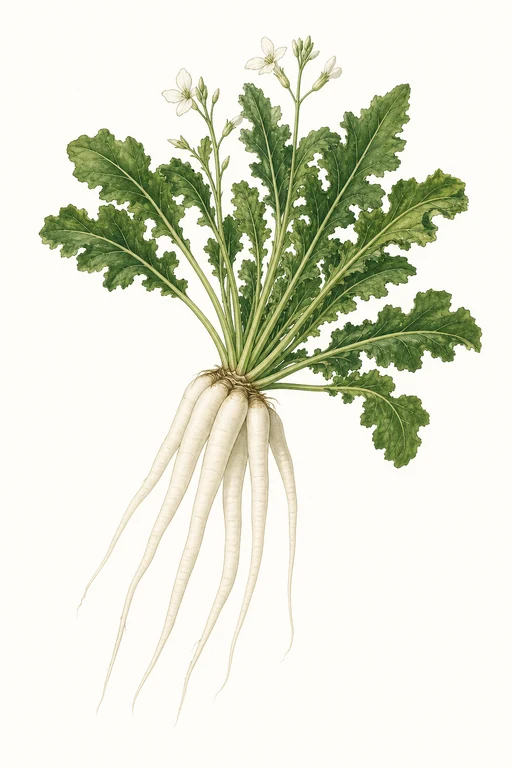
White Icicle
Radish
🌱 30d to harvest
Taproot
Crisp as fresh-cut glass, White Icicle radish offers a luminous, snow-white snap with a delicately sweet, mildly peppery finish. …
Crop Dates
| Milestone | Date |
|---|---|
| Start Indoors | Direct Sow |
| Last Frost | Jan 1st |
| Transplant / Sow Outdoors | Jan 1st |
| Harvest Begins | Jan 31st |
| Harvest Ends | Dec 31st |
Crop Details
| Trait | Value |
|---|---|
| Days to Maturity | 30 |
| Sun Requirements | Full Sun |
| Growth Habit | Taproot |
| Support Needed | None |
| Planting Depth | Normal |
| Germination Temp (°F) | 55 |
| Min Soil Temp (°F) | 40 |
| Min Night Temp (°F) | 28 |
| Harden Off (days) | Not Required |
Recommended Companions
Frequently Asked Questions
Why are my Raphanus sativus (white icicle radish) leaves turning yellow and holes appearing, and what should I do?
Yellowing with ragged holes is often flea beetle damage, while soggy spots and wilting can indicate damping-off in cool, wet soil. Cover seedlings with a fine insect net or row cover immediately after sowing, and keep the bed weed-free to reduce flea beetle habitat. Water at the soil level and avoid keeping the seed row constantly wet to prevent damping-off; if you see damping-off, remove affected seedlings and improve drainage before resowing in another spot.
How often should I water Raphanus sativus during the main growing phase to keep roots crisp and prevent splitting?
During the 3–4 weeks to maturity, keep the top 1–2 inches of soil consistently evenly moist so the roots swell quickly. In most home gardens this means watering about 1 inch per week total, split into 2–3 waterings, and adjusting to rainfall and heat. Letting the bed dry out then flooding it after will encourage cracking or pithiness, so aim for steady moisture from sprouting to harvest.
How can I tell when my white icicle radishes are ready to harvest?
Harvest at about 30 days, or as soon as the roots are clearly elongated and firm—typically when they reach roughly the size of a thumb and the shoulders show above the soil. Don’t wait too long after they’re full size, because Brassicaceae radishes (including Raphanus sativus) can become woody and hot-tasting. Pull one to check firmness; if it bends easily or feels soft, give the rest 2–3 more days and recheck.