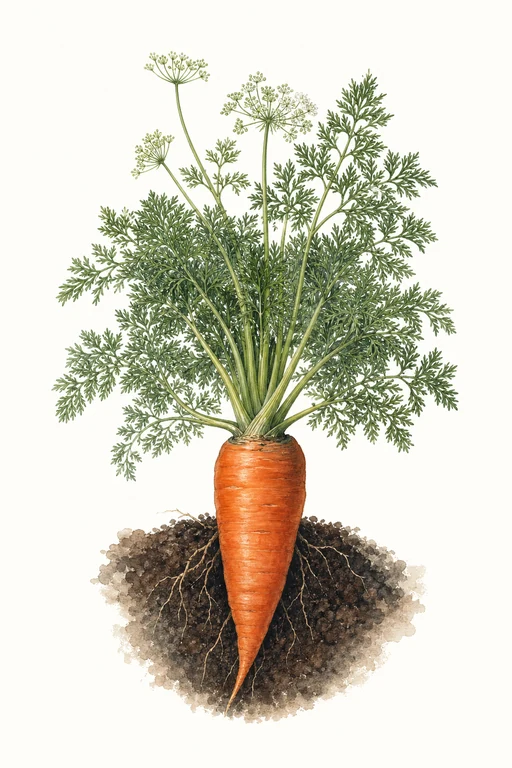
Bolero Carrot
Carrot
🌱 75d to harvest
Taproot
Sweetly fragrant and richly colored, Bolero Carrot develops into a classic Danvers silhouette with a smooth, firm core and a cris…
Crop Dates
| Milestone | Date |
|---|---|
| Start Indoors | Direct Sow |
| Last Frost | Jan 1st |
| Transplant / Sow Outdoors | Jan 1st |
| Harvest Begins | Mar 17th |
| Harvest Ends | — |
Crop Details
| Trait | Value |
|---|---|
| Days to Maturity | 75 |
| Sun Requirements | Full Sun |
| Growth Habit | Taproot |
| Support Needed | None |
| Planting Depth | Normal |
| Germination Temp (°F) | 75 |
| Min Soil Temp (°F) | 40 |
| Min Night Temp (°F) | 28 |
| Harden Off (days) | Not Required |
Recommended Companions
Frequently Asked Questions
What should I do if my Bolero carrots get Alternaria leaf blight or show dark, dry leaf spots?
In Bolero carrots, Alternaria blight shows up as brown-to-black, dry lesions on leaf tips and edges that spread in warm, humid weather. Remove and discard badly affected tops, improve airflow by thinning seedlings to about 1–2 inches apart, and avoid overhead watering—water the soil at the base instead. If the problem keeps spreading, use a labeled fungicide for carrots/leaf blight and begin treatments early at the first spotting stage.
How often should I water Bolero carrots during the main growth phase to get straight roots?
From when seedlings are established through root bulking (most of the ~75 days), keep the soil evenly moist—aim for about 1 inch of water per week total, adjusted for heat and rainfall. Water in shorter, frequent cycles (e.g., 2–3 times per week) rather than one heavy soaking, so the soil doesn’t dry out then flood, which can cause cracking and forked roots. Check moisture 1–2 inches down; if it feels dry there, water, and if it’s muddy or soggy, reduce the frequency.
How can I tell when Bolero carrots are ready to harvest?
Bolero carrots are typically ready around 70–80 days after sowing; start checking from day 65 by gently pulling back mulch and exposing the crown. Harvest when the shoulders are firm and sized (about 3/4 to 1 inch across for many home plantings) and the roots look bright orange and well-filled. Don’t wait for leaves to collapse—over-mature roots can become woody and less sweet.