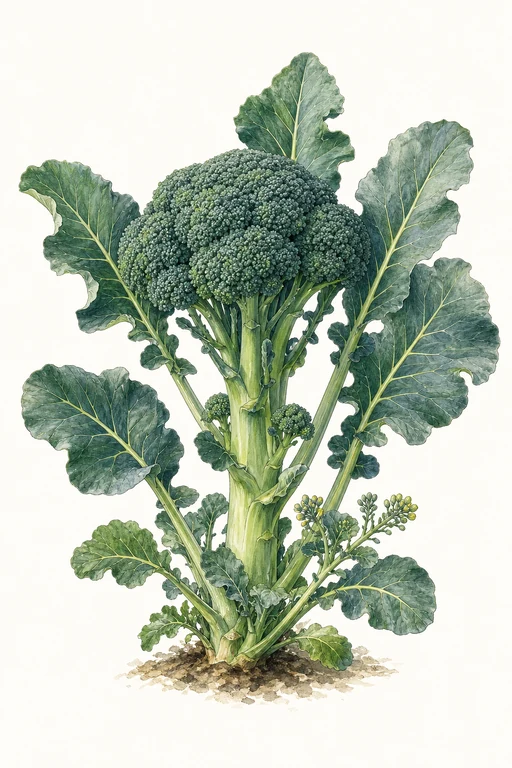
Calabrese
70d to harvest
Sink your senses into Calabrese’s rich, blue-green florets—dense, finely textured heads that feel almost velvety at first glance. With its steady, upright growth and reliable 70-day maturity, this variety delivers a sweet, tender bite and a satisfying snap, followed by flavorful side shoots for an extended harvest window. Ideal for roasting, steaming, and fresh florets in salads, Calabrese also shines in hearty sauces and quick pickles when you want its color and character to stay bright.
Crop Dates
| Milestone | Date |
|---|---|
| Start Indoors | Apr 27th |
| Last Frost | May 25th |
| Transplant / Sow Outdoors | May 25th |
| Harvest Begins | Aug 3rd |
| Harvest Ends | Aug 29th |
Crop Details
| Trait | Value |
|---|---|
| Days to Maturity | 70 |
| Sun Requirements | Full Sun |
| Growth Habit | Rosette |
| Support Needed | None |
| Planting Depth | Normal |
| Germination Temp (°F) | 45 |
| Min Soil Temp (°F) | 40 |
| Min Night Temp (°F) | 30 |
| Harden Off (days) | 6 |
Recommended Companions
Frequently Asked Questions
What pest or disease most commonly affects Calabrese (Brassica oleracea var. italica), and how do I treat it?
Black rot and other Brassica leaf rots can show up as yellow V-shaped spots starting at leaf edges, often followed by dark, spreading lesions. Remove and discard affected leaves, avoid wetting the foliage, and don’t reuse infected plant debris—rotate Brassicas away from the bed for at least 3 years. For pests, watch for cabbage worms and check undersides of leaves; pick off early larvae and apply an appropriate BT (Bacillus thuringiensis) treatment when small caterpillars are present.
How often should I water Calabrese during the main growing phase?
During head development (roughly mid-season until harvest), keep the soil consistently evenly moist, not waterlogged—aim for about 1 to 1.5 inches of water per week depending on rainfall. Water deeply at the base to prevent leaf wetness, and adjust to maintain steady moisture because uneven drying can lead to loose heads. Mulch after plants are established to reduce moisture swings, which are especially harmful for Brassica heads.
How can I tell when Calabrese is ready to harvest?
Harvest when the central head is tight and compact with florets still firm and dark green, before any noticeable yellowing or flowering opens. The head should be about 4–7 inches across (varies by plant), and you’ll typically see side shoots forming right after the main cut. Cut the central head with a sharp knife and leave several inches of stem; the plant will produce side shoots for additional harvests over the following weeks.