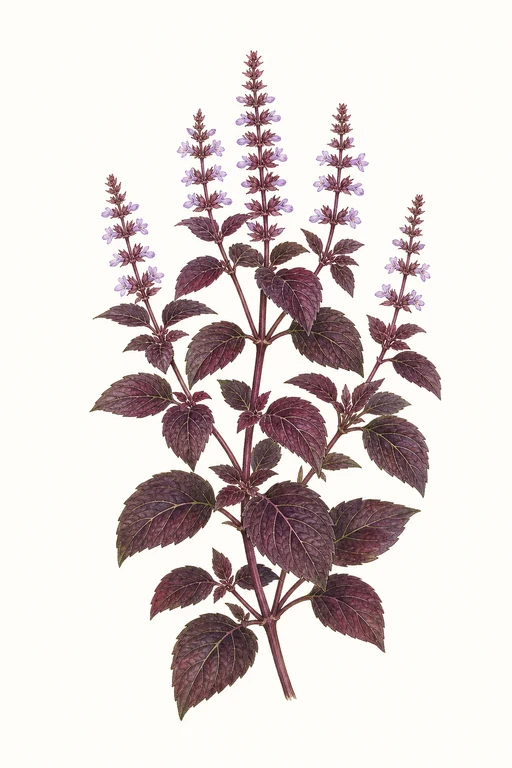
Red Holy Basil
Basil
🌱 60d to harvest
Upright
Fragrant as a warm breeze—Red Holy Basil carries a rich, clove-tinged basil aroma with a distinctly deep, wine-red undertone that…
Crop Dates
| Milestone | Date |
|---|---|
| Start Indoors | Apr 1st |
| Last Frost | May 13th |
| Transplant / Sow Outdoors | Jul 1st |
| Harvest Begins | Aug 30th |
| Harvest Ends | Sep 27th |
Crop Details
| Trait | Value |
|---|---|
| Days to Maturity | 60 |
| Sun Requirements | Full Sun |
| Growth Habit | Upright |
| Support Needed | None |
| Planting Depth | Normal |
| Germination Temp (°F) | 70 |
| Min Soil Temp (°F) | 60 |
| Min Night Temp (°F) | 50 |
| Harden Off (days) | 10 |
Recommended Companions
Frequently Asked Questions
What pest or disease commonly affects Ocimum tenuiflorum (red holy basil), and how can I treat it?
Holy basil (Ocimum tenuiflorum) is prone to leaf fungal spots when foliage stays wet and airflow is poor. At the first sign of spotting, remove affected leaves, water at the soil line, and thin plants so leaves dry quickly; improve airflow around the crown. If spotting spreads, use a labeled copper-based fungicide and reapply according to the label after 5–7 days.
How often should I water red holy basil during the main growing phase?
During active growth, keep the top 1–2 inches of soil lightly moist but never waterlogged—typically this means watering about once every 2–4 days depending on heat and container size. Aim for deep watering that penetrates the root zone, then let the soil surface dry slightly before the next watering. Consistent moisture supports leaf production, while soggy soil can trigger root stress and leaf diseases.
How do I tell when Ocimum tenuiflorum is ready to harvest?
Harvest starting around 45–60 days when plants are well branched and have strong leaf growth, continuing as long as new shoots are forming. Pick the top 6–8 inches of growth (or pinch off stem tips) before flowers open for the best leaf flavor and aroma. If you see buds forming and the plant starts redirecting energy to flowering, begin harvesting more selectively to avoid reducing regrowth.