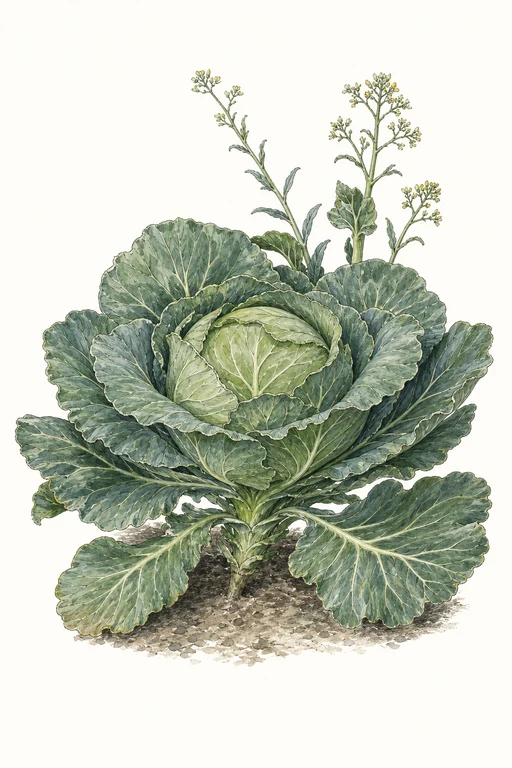
Flat Dutch Giant
Cabbage
🌱 100d to harvest
Rosette
Sink your senses into Flat Dutch Giant’s crisp, cool crunch—an invitingly mild, cabbage-sweet flavor with a satisfyingly firm bit…
Crop Dates
| Milestone | Date |
|---|---|
| Start Indoors | Mar 28th |
| Last Frost | Apr 25th |
| Transplant / Sow Outdoors | Apr 25th |
| Harvest Begins | Aug 3rd |
| Harvest Ends | Oct 16th |
Crop Details
| Trait | Value |
|---|---|
| Days to Maturity | 100 |
| Sun Requirements | Full Sun |
| Growth Habit | Rosette |
| Support Needed | None |
| Planting Depth | Normal |
| Germination Temp (°F) | 45 |
| Min Soil Temp (°F) | 40 |
| Min Night Temp (°F) | 30 |
| Harden Off (days) | 6 |
Recommended Companions
Frequently Asked Questions
What pest or disease is most common on Brassica oleracea var. capitata (Flat Dutch Giant cabbage), and how do I treat it?
Watch for cabbage worms (imported cabbageworm/diamondback moth) and clubroot. For worms, spray Bt (Bacillus thuringiensis) when you first see small holes or tiny green larvae, and reapply after 5–7 days if needed. To reduce clubroot, avoid planting in the same bed for several years, keep soil moisture consistent (not waterlogged), and apply lime according to a soil test to maintain a near-neutral pH.
How often should I water Flat Dutch Giant cabbage during the main head-forming phase?
During head formation (roughly mid-season onward), keep soil evenly moist about 1–1.5 inches per week total, split as needed to prevent drying out completely between waterings. Water deeply so moisture reaches the root zone, then let the top couple inches dry slightly to avoid stagnant, soggy soil that encourages disease. Irregular moisture can lead to stunted heads and increased risk of cracking.
How can I tell when Flat Dutch Giant cabbage is ready to harvest?
Harvest when heads feel firm and solid in the center and reach a good size for “giant” types, typically around 100 days from sowing (your exact date depends on transplant time). If you squeeze the head gently, it should resist compression, not feel soft or springy. Leave it a bit longer only if weather stays mild—hard frosts can damage outer leaves even if the core is close to ready.