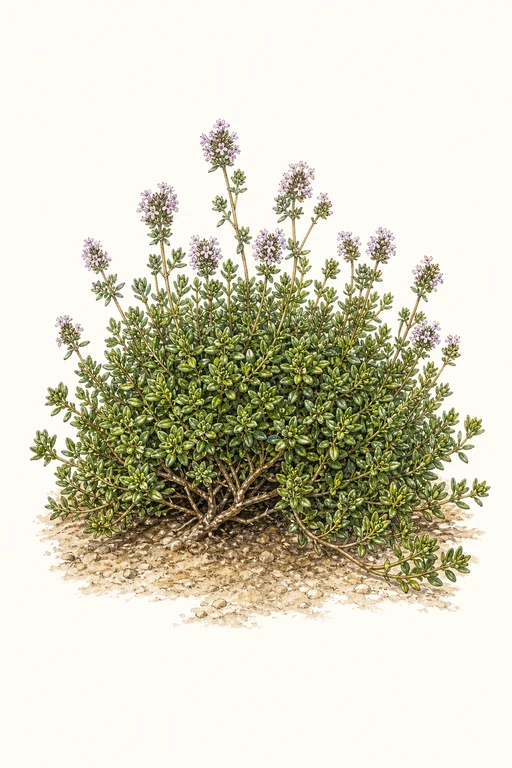
Orange Balsam Thyme
Thyme
🌱 75d to harvest
Upright
Sunlit citrus notes rise first—Orange Balsam Thyme carries a warm, orange-gold fragrance with a softly resinous, thyme-bright fin…
Crop Dates
| Milestone | Date |
|---|---|
| Start Indoors | Mar 14th |
| Last Frost | Apr 25th |
| Transplant / Sow Outdoors | Jun 6th |
| Harvest Begins | Aug 20th |
| Harvest Ends | Oct 16th |
Crop Details
| Trait | Value |
|---|---|
| Days to Maturity | 75 |
| Sun Requirements | Full Sun |
| Growth Habit | Upright |
| Support Needed | None |
| Planting Depth | Normal |
| Germination Temp (°F) | 70 |
| Min Soil Temp (°F) | 45 |
| Min Night Temp (°F) | 40 |
| Harden Off (days) | 7 |
Recommended Companions
Frequently Asked Questions
What’s a common disease problem for Thymus vulgaris (Orange Balsam Thyme), and how do I stop it?
The most common issue is root rot from consistently wet soil, which often shows up as wilting and browning at the base. Water only when the top 1–2 in (2–5 cm) of soil feels dry, and make sure your pot/bed drains freely with gritty, well-drained soil. If you catch it early, reduce watering immediately and improve drainage (for containers, use a potting mix with extra perlite or grit); heavily affected plants may need removal to prevent spread.
How often should I water Orange Balsam Thyme during active growth?
During the main growing season, water deeply but infrequently: typically every 7–10 days in average conditions, and more like every 3–6 days during hot, dry spells. Aim for evenly moist soil only until plants establish, then shift to letting the top layer dry between waterings—Thymus vulgaris prefers dry-to-moderately-dry conditions. Avoid frequent misting or shallow watering that keeps the root zone damp.
How can I tell when Orange Balsam Thyme is ready to harvest (Thymus vulgaris, ~75 days)?
Harvest when plants are well-established and have lots of fragrant growth—about 75 days from sowing for best results, or once stems are at least 4–6 in (10–15 cm) long. Pick in the morning before heat, snipping young, non-woody tips; you’ll know they’re ready when the leaves are fully formed and strongly aromatic when rubbed. For the best flavor, don’t strip more than about one-third of the plant at a time—then let it regrow.