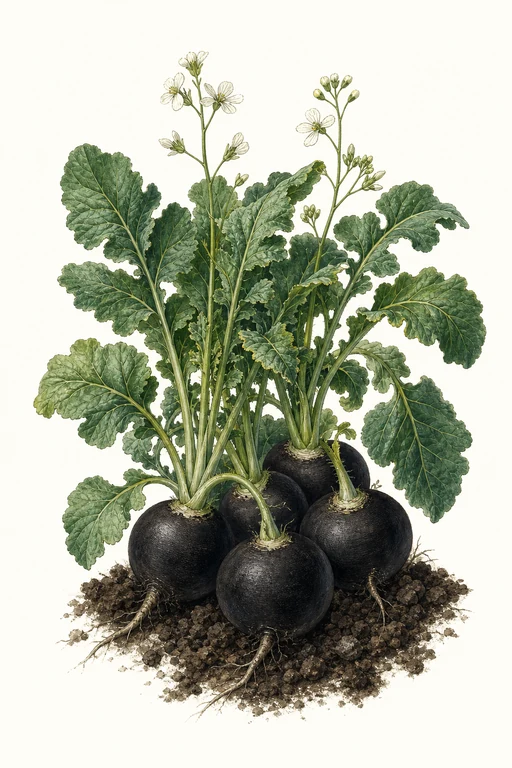
Black Spanish Round
Radish
🌱 70d to harvest
Taproot
Sink your senses into Black Spanish Round’s velvety, inky skin—nearly black with a subtle charcoal sheen—giving way to crisp, whi…
Crop Dates
| Milestone | Date |
|---|---|
| Start Indoors | Direct Sow |
| Last Frost | Mar 6th |
| Transplant / Sow Outdoors | Mar 6th |
| Harvest Begins | May 15th |
| Harvest Ends | Nov 26th |
Crop Details
| Trait | Value |
|---|---|
| Days to Maturity | 70 |
| Sun Requirements | Full Sun |
| Growth Habit | Taproot |
| Support Needed | None |
| Planting Depth | Normal |
| Germination Temp (°F) | 55 |
| Min Soil Temp (°F) | 45 |
| Min Night Temp (°F) | 28 |
| Harden Off (days) | Not Required |
Recommended Companions
Frequently Asked Questions
Why are my Black Spanish Round plants developing powdery white patches on leaves, and what should I do?
Powdery mildew commonly appears as a white, flour-like coating on cucumber/melon-type leaves (or related vine crops) in warm, humid stretches. Remove the worst affected leaves, avoid wetting foliage, and increase airflow by spacing vines and pruning lightly. If it keeps spreading, treat early with a sulfur-based fungicide labeled for food gardens and follow the label’s timing before harvest (Black Spanish Round is typically ready around 70 days).
How often should I water Black Spanish Round during the main growing phase to keep fruit setting well?
During active growth and fruit fill, keep the soil consistently moist but never soggy—aim for about 1 inch (2.5 cm) of water per week, adjusting for heat and rainfall. Water deeply at the base of the plant 1–2 times per week rather than frequent light sprinkles, and stop short of letting the soil dry out completely. Mulch helps reduce swings, which helps prevent misshapen fruit and stress-related leaf problems.
How do I tell when Black Spanish Round is ready to harvest?
Harvest when fruits reach full color and size for the variety, typically around 70 days after planting, and the skin feels firm with a deep, uniform dark color. If you gently lift the fruit and it separates cleanly or the stem dulls slightly, it’s usually ready—don’t wait until it gets soft. For best flavor, harvest in the morning and avoid leaving fruit on vines through heavy heat spikes.