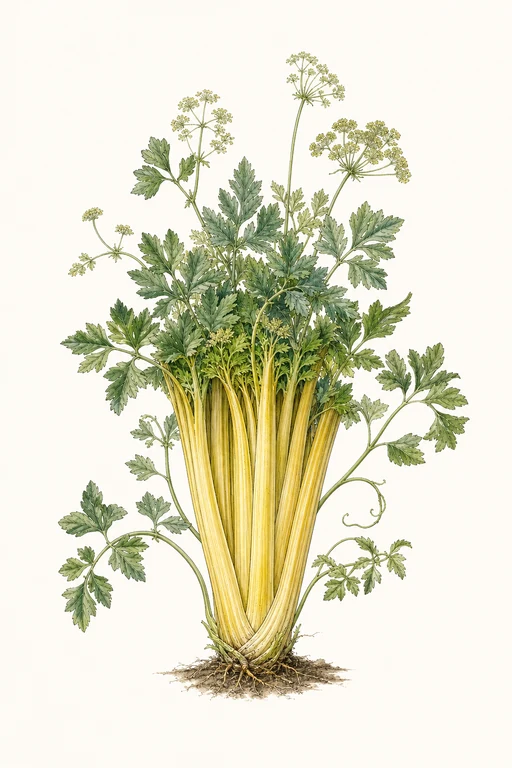
Dorato D'Asti
Celery
🌱 120d to harvest
Rosette
Fragrant and luminous, Dorato D’Asti brings a golden, sun-kissed celery heart with a crisp snap and a clean, herbal sweetness. Ex…
Crop Dates
| Milestone | Date |
|---|---|
| Start Indoors | Dec 26th |
| Last Frost | Mar 6th |
| Transplant / Sow Outdoors | Feb 27th |
| Harvest Begins | Jun 27th |
| Harvest Ends | Nov 26th |
Crop Details
| Trait | Value |
|---|---|
| Days to Maturity | 120 |
| Sun Requirements | Part Sun |
| Growth Habit | Rosette |
| Support Needed | None |
| Planting Depth | Normal |
| Germination Temp (°F) | 70 |
| Min Soil Temp (°F) | 40 |
| Min Night Temp (°F) | 28 |
| Harden Off (days) | 7 |
Recommended Companions
Frequently Asked Questions
What pest or disease commonly affects Apium graveolens (self-blanching celery) like Dorato D’Asti, and how can I manage it?
Celery commonly suffers from fungal leaf blights and early blight–type spotting, especially when the foliage stays wet. Water at the soil line (not over the leaves), improve airflow by spacing plants, and remove yellowing or spotted outer leaves early; if spots spread, treat with a labeled copper or chlorothalonil fungicide per label directions. Aphids may also show up; knock them off with a strong water spray and, if needed, use insecticidal soap to protect new growth.
How often should I water Dorato D’Asti celery during active growth, and what soil moisture level should I aim for?
During the main growth phase (from establishment through bulking), keep the root zone consistently moist—about 1 to 1.5 inches of water per week, adjusted for heat and rainfall. Aim for evenly damp soil (not soggy): if the top 1 inch dries out, water deeply, and if the soil stays wet or smells anaerobic, cut back to prevent rot. Mulch helps stabilize moisture so the stalks thicken without cracking from drying-wetting cycles.
How do I know when Dorato D’Asti self-blanching celery is ready to harvest?
Harvest at around 120 days from sowing/transplanting timing for your schedule, when stalks are thick, firm, and reach a usable height with crisp texture. The best indicator is that the outer stalks are fully developed and no longer feel stringy when you gently pull one toward you. If you use blanching by earthen mounding or tying, wait until the stalks have blanched well and the heads look tight and dense before cutting at the base.