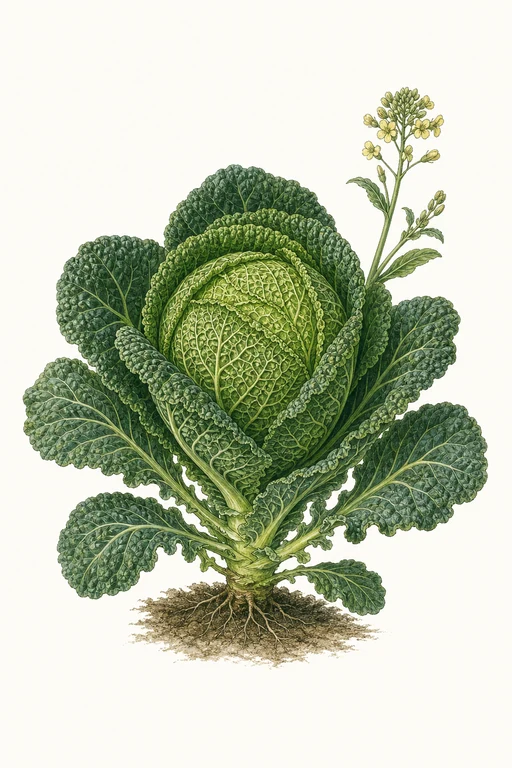
Winter King Savoy
Cabbage
🌱 75d to harvest
Rosette
Winter King Savoy brings a silken, deeply crinkled green that feels almost velvety in the garden—tight heads form with a regal, l…
Crop Dates
| Milestone | Date |
|---|---|
| Start Indoors | Feb 6th |
| Last Frost | Mar 6th |
| Transplant / Sow Outdoors | Feb 27th |
| Harvest Begins | May 13th |
| Harvest Ends | Nov 26th |
Crop Details
| Trait | Value |
|---|---|
| Days to Maturity | 75 |
| Sun Requirements | Full Sun |
| Growth Habit | Rosette |
| Support Needed | None |
| Planting Depth | Normal |
| Germination Temp (°F) | 45 |
| Min Soil Temp (°F) | 40 |
| Min Night Temp (°F) | 30 |
| Harden Off (days) | 6 |
Recommended Companions
Frequently Asked Questions
What pest or disease commonly affects Brassica oleracea var. capitata (Savoy cabbage), and what should I do?
Cabbage worms (imported cabbageworm or cabbage looper) chew ragged holes in savoy leaves, and they’re hardest to catch early. Inspect plants 2–3 times per week and hand-pick larvae when you see them; follow up with an application of Bt (Bacillus thuringiensis) to target young caterpillars while leaves are still forming. If you notice pale, silvery leaf spotting or white flecks that expand into chewing damage, re-check underside of leaves and re-apply Bt according to the label timing.
How often should I water Winter King Savoy during the main head-forming phase?
During the 2–3 weeks when heads are forming, keep soil consistently evenly moist—aim for about 1 inch of water per week total, split into 2–3 deep waterings if it’s hot or dry. Check by digging 2–3 inches down: if it feels dry at that depth, water; if it stays wet, slow down to prevent soggy roots that can predispose plants to rot.
How can I tell when my Winter King Savoy is ready to harvest?
Harvest when heads are firm to the touch and have reached a full, tight savoy texture (about 75 days from transplanting/typical schedule). Lift one leaf to look for a solid core—if it feels springy or easily compresses, give it a few more days. Cut with a sharp knife just above soil level, and don’t wait for heads to split.