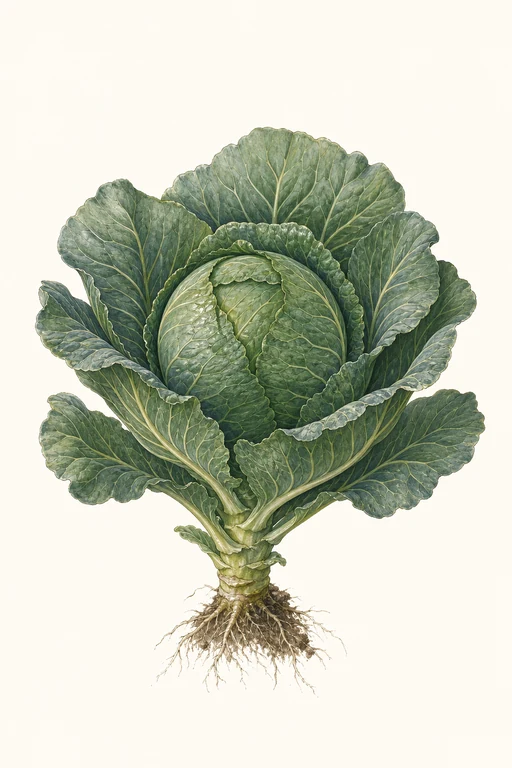
Danish Ballhead
Cabbage
🌱 90d to harvest
Rosette
Crisp, cool-sweet leaves form a dense, ballhead crown that feels satisfyingly weighty in the garden—each fold tight as lace, with…
Crop Dates
| Milestone | Date |
|---|---|
| Start Indoors | Jan 12th |
| Last Frost | Feb 9th |
| Transplant / Sow Outdoors | Feb 9th |
| Harvest Begins | May 10th |
| Harvest Ends | Dec 9th |
Crop Details
| Trait | Value |
|---|---|
| Days to Maturity | 90 |
| Sun Requirements | Full Sun |
| Growth Habit | Rosette |
| Support Needed | None |
| Planting Depth | Normal |
| Germination Temp (°F) | 45 |
| Min Soil Temp (°F) | 40 |
| Min Night Temp (°F) | 35 |
| Harden Off (days) | 6 |
Recommended Companions
Frequently Asked Questions
What’s the most common disease or pest problem for Brassica oleracea var. capitata (cabbage) like Danish Ballhead, and how do I fix it?
Cabbage is commonly hit by cabbage worms (cabbage loopers and imported cabbageworms) that chew holes in leaves, especially after heads start forming. Hand-pick larvae in the evening and cover plants with a lightweight row cover as soon as seedlings are in the ground to prevent egg laying; if needed, spot-treat with an appropriate Bt (Bacillus thuringiensis) product, following the label. Watch for black “frass” and chewed leaf edges and act early—once feeding is heavy, head quality drops quickly.
How often should I water Danish Ballhead cabbage during the main head-forming stage?
During the main growing phase as heads begin to form (roughly after you see firming toward the center), keep soil consistently evenly moist—about 1 inch (2.5 cm) of water per week, split into 2–3 waterings if it’s hot or windy. Let the top few centimeters dry slightly between waterings, but don’t allow the root zone to dry out for extended periods; stress can lead to loose heads and splitting later. Mulch helps keep moisture steady, but avoid waterlogged soil that stays soggy.
How can I tell when Danish Ballhead cabbage is ready to harvest?
Harvest at about 90 days when the heads are firm and reach their full size, with leaves tightly packed rather than springy. Check by gently pressing the outer head—if it feels hard and dense across the whole top, it’s ready; if it still feels soft or opens easily, wait. If you see heads beginning to split, harvest immediately to prevent further cracking and leaf damage.