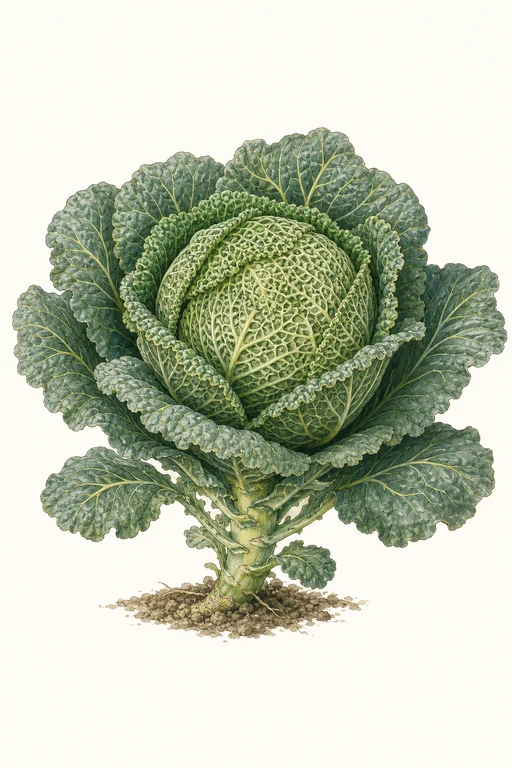
Savoy Express
Cabbage
🌱 70d to harvest
Rosette
Savoy Express unfurls with a lush, deeply crinkled canopy that feels like velvet under the fingertips—its tight head forms a hand…
Crop Dates
| Milestone | Date |
|---|---|
| Start Indoors | Jan 12th |
| Last Frost | Feb 9th |
| Transplant / Sow Outdoors | Feb 2nd |
| Harvest Begins | Apr 13th |
| Harvest Ends | Dec 9th |
Crop Details
| Trait | Value |
|---|---|
| Days to Maturity | 70 |
| Sun Requirements | Full Sun |
| Growth Habit | Rosette |
| Support Needed | None |
| Planting Depth | Normal |
| Germination Temp (°F) | 75 |
| Min Soil Temp (°F) | 45 |
| Min Night Temp (°F) | 30 |
| Harden Off (days) | 6 |
Recommended Companions
Frequently Asked Questions
What pest or disease is most likely on Brassica oleracea var. capitata (savoy) and how do I control it?
Watch for cabbage worms (Imported cabbageworm/diamondback moth larvae) and aphids, which commonly chew savoy leaves and leave frass on the cabbage head. Inspect weekly and hand-pick larvae when you see them, then spray an appropriate Bt (Bacillus thuringiensis) product for caterpillars or insecticidal soap for aphids, applying in the evening for better coverage. If you notice blackened stems or leaves and poor growth, remove affected plants early to reduce spread, and avoid replanting brassicas in the same spot for at least 3 years.
How often should I water Brassica oleracea var. capitata during the main head-forming phase?
During the main growing phase (from when plants start forming heads until harvest), keep the soil evenly moist—aim for about 1–1.5 inches (2.5–4 cm) of water per week depending on heat and rainfall. Water deeply so moisture reaches the root zone, then let the top 1 inch (2.5 cm) of soil dry slightly before watering again to prevent rot while avoiding stress that can cause loose heads. In hot spells, check more often because savoy can wilt quickly in full sun.
How can I tell when savoy cabbage is ready to harvest?
Harvest when heads reach a firm, dense feel and the outer leaves look fully developed, typically around 70 days from transplanting for this type. The head should resist gentle pressure—if it compresses easily, give it a bit more time. Cut heads at the base in the morning for best texture, leaving a few outer leaves to protect the head.