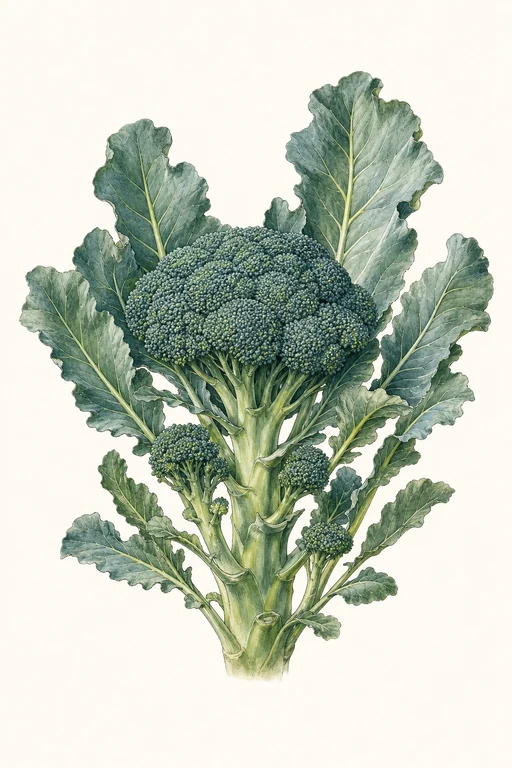
Waltham 29
Broccoli
🌱 75d to harvest
Rosette
Fragrant, cool-sweet florets arrive in a steady wave—Waltham 29 forms a dense, medium-to-large head with a deep blue-green cast a…
Crop Dates
| Milestone | Date |
|---|---|
| Start Indoors | Dec 19th |
| Last Frost | Jan 16th |
| Transplant / Sow Outdoors | Jan 16th |
| Harvest Begins | Apr 1st |
| Harvest Ends | Dec 19th |
Crop Details
| Trait | Value |
|---|---|
| Days to Maturity | 75 |
| Sun Requirements | Full Sun |
| Growth Habit | Rosette |
| Support Needed | None |
| Planting Depth | Normal |
| Germination Temp (°F) | 45 |
| Min Soil Temp (°F) | 40 |
| Min Night Temp (°F) | 32 |
| Harden Off (days) | 6 |
Recommended Companions
Frequently Asked Questions
What’s a common broccoli pest or disease for Brassica oleracea var. italica, and how do I treat it?
Black rot (Xanthomonas) often starts as V-shaped yellowing at leaf edges and can spread through the plants, especially in warm, wet weather. Remove and discard infected heads/leaves below the damage, avoid overhead irrigation, and sanitize tools; if you’ve had black rot repeatedly, start with new transplants in clean beds. For pests, watch for cabbage worms (importantly the larvae of cabbage moths); hand-pick early and use a floating row cover to prevent egg laying.
How often should I water Waltham 29 during active head formation?
During the main growth and head-filling phase (roughly from when heads form until harvest), keep the soil consistently evenly moist—about 1 to 1.5 inches (2.5–4 cm) of water per week total from rain plus irrigation. Water deeply so moisture reaches the root zone, then let the top 1 inch (2.5 cm) of soil dry slightly before watering again to reduce disease pressure.
How can I tell when Waltham 29 is ready to harvest?
Harvest when the central head is fully formed and the individual flower buds are still tightly closed (green to dark green), before they loosen or begin to yellow. If the head is starting to separate into visible, loosening buds, it’s already past prime. Cut the main head with 5–7 inches (12–18 cm) of stem; this Brassica oleracea var. italica type often produces smaller side shoots afterward.