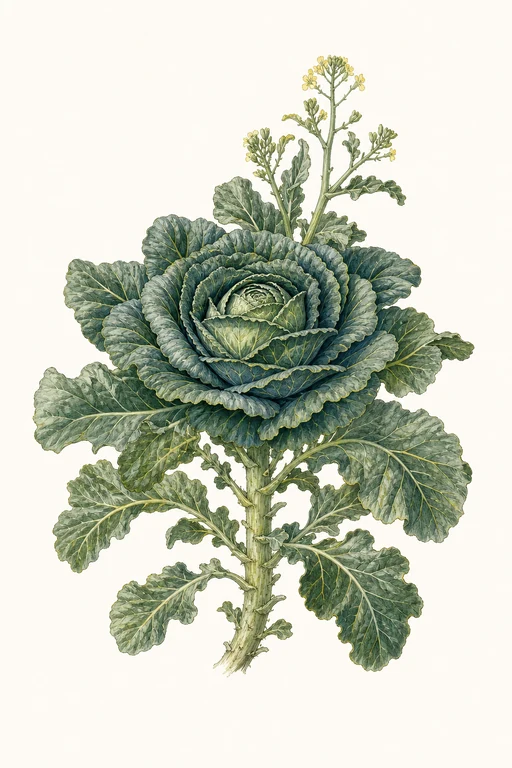
Glory Of Enkhuizen
Cabbage
🌱 85d to harvest
Rosette
Glory Of Enkhuizen brings a richly satisfying, cool-sweet crunch to the garden—heads form with a dense, flat-to-slightly-rounded …
Crop Dates
| Milestone | Date |
|---|---|
| Start Indoors | Dec 4th |
| Last Frost | Jan 1st |
| Transplant / Sow Outdoors | Jan 1st |
| Harvest Begins | Mar 27th |
| Harvest Ends | — |
Crop Details
| Trait | Value |
|---|---|
| Days to Maturity | 85 |
| Sun Requirements | Full Sun |
| Growth Habit | Rosette |
| Support Needed | None |
| Planting Depth | Normal |
| Germination Temp (°F) | 45 |
| Min Soil Temp (°F) | 40 |
| Min Night Temp (°F) | 35 |
| Harden Off (days) | 6 |
Recommended Companions
Frequently Asked Questions
What pest or disease commonly hits Brassica oleracea var. capitata (cabbage) and how do I control it at home?
Watch for cabbage worms (cabbage loopers/diamondback moth larvae) which chew holes in leaves and frass on the outer foliage. Hand-pick small larvae and spray an organic option like Bacillus thuringiensis (Bt) so it contacts the young caterpillars, repeating as new eggs hatch. If you see yellowing and wilting that doesn’t rebound, check for clubroot (swollen roots) and remove affected plants—don’t replant Brassica in the same bed.
How often should I water cabbage during the main head-forming period?
During head formation (roughly the last 4–6 weeks), keep soil evenly moist but not waterlogged—about 1–1.5 inches (2.5–4 cm) per week total, adjusted for rainfall and heat. Water deeply so moisture reaches the root zone, then let the top few centimeters dry slightly before watering again to prevent split heads from irregular moisture. Mulch helps keep that consistent moisture level around the plants.
How can I tell when Glory Of Enkhuizen cabbage is ready to harvest?
Harvest at about 85 days when the heads feel firm to the touch and stop enlarging, with tightly packed leaves forming a solid, dense sphere. The outer leaves should look full and sturdy; if the head feels springy or compresses easily, it needs more time. Cut the head with a sharp knife, leaving a small outer-stem stub, and harvest before prolonged heat or stress to reduce splitting.