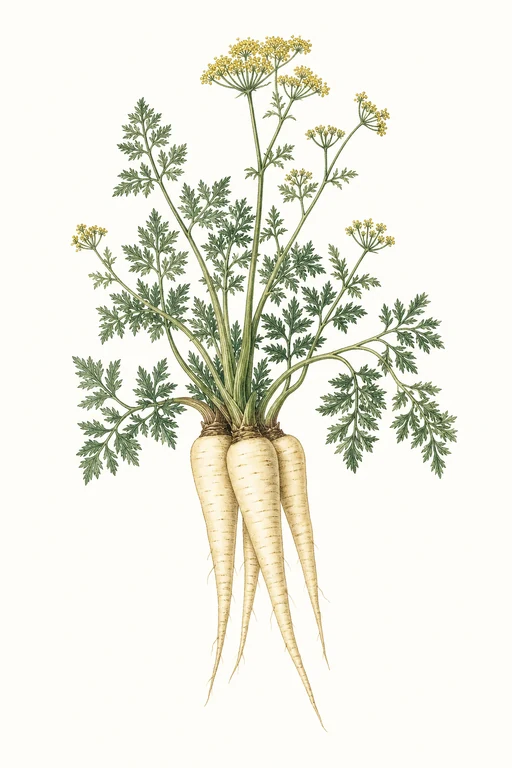
Lancer
🌱 105d to harvest
Taproot
Sweetly fragrant from the first pull, Lancer parsnips develop a long, tapered form with a creamy, ivory interior and a gently hon…
Crop Dates
Growing note: Zone 1a has only 30 frost-free days — shorter than this crop's 105-day maturity. Outdoor planting is not viable; use protected cultivation.
| Milestone | Date |
|---|---|
| Last Frost | Jun 15th |
| Growing Approach | Protected Environment Only |
Crop Details
| Trait | Value |
|---|---|
| Days to Maturity | 105 |
| Sun Requirements | Full Sun |
| Growth Habit | Taproot |
| Support Needed | None |
| Planting Depth | Normal |
| Germination Temp (°F) | 50 |
| Min Soil Temp (°F) | 40 |
| Min Night Temp (°F) | 28 |
| Harden Off (days) | Not Required |
Recommended Companions
Frequently Asked Questions
What’s the most common pest or disease problem for Pastinaca sativa (parsnip), and how do I treat it?
Parsnips commonly suffer from Alternaria leaf blight, which shows up as dark, irregular spots on the foliage and can reduce growth. Remove and discard infected leaves early, improve airflow with wider spacing, and avoid wetting the foliage with overhead watering. If the problem spreads, repeat-labeled fungicides may be used, but start treatments as soon as spotting appears and follow all label directions.
How often should I water Pastinaca sativa during the main growing phase?
During active root development, keep the soil consistently moist but not soggy—aim for about 1 inch of water per week, adjusted for heat and rainfall. Water deeply when the top 1 inch of soil starts to dry, because parsnips need steady moisture to form straight, fleshy roots. Mulch lightly to reduce fluctuations, which helps prevent cracking and forked roots.
How can I tell when my parsnips (Pastinaca sativa) are ready to harvest?
Harvest at roughly 105 days from sowing, when the roots reach typical size and the tops look vigorous and then start to naturally decline. You’ll feel a firm crown at the soil line and the roots should be thick enough to hold their shape. For best sweetness, leave roots in the ground after maturity for a light frost; if foliage dies back, dig promptly to prevent rotting.