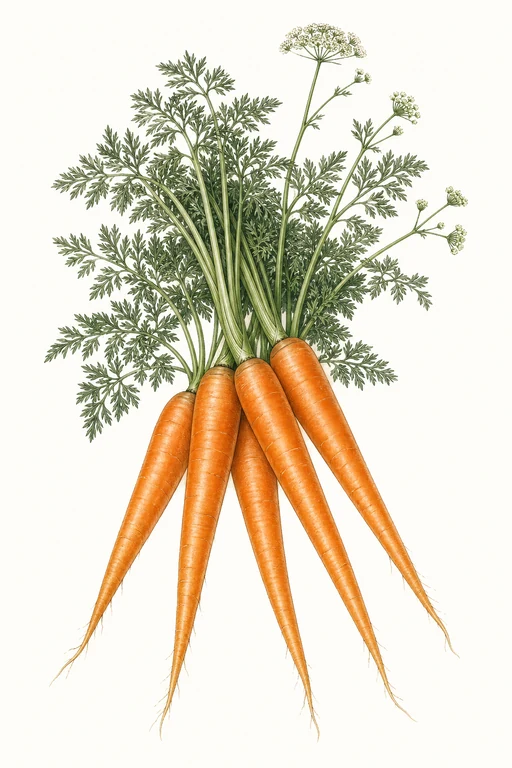
Nelson
65d to harvest
Sweetly earthy and sun-warmed from the first bite, Nelson Nantes carrots form a smooth, tapered root with a crisp, fine-grained snap and a richly orange core. At maturity (about 65 days), the slender shoulders and uniform length make them especially satisfying for fresh pulling, roasting, and brightening into vivid sauces—plus they’re ideal for pickling when you want color that stays bold.
Crop Dates
Growing note: Zone 1a has only 30 frost-free days — shorter than this crop's 65-day maturity. Outdoor planting is not viable; use protected cultivation.
| Milestone | Date |
|---|---|
| Last Frost | Jun 15th |
| Growing Approach | Protected Environment Only |
Crop Details
| Trait | Value |
|---|---|
| Days to Maturity | 65 |
| Sun Requirements | Full Sun |
| Growth Habit | Taproot |
| Support Needed | None |
| Planting Depth | Normal |
| Germination Temp (°F) | 70 |
| Min Soil Temp (°F) | 40 |
| Min Night Temp (°F) | 28 |
| Harden Off (days) | Not Required |
Recommended Companions
Frequently Asked Questions
What pest or disease is most common on carrots (Daucus carota var. sativus) and how do I treat it?
Carrots are commonly hit by carrot rust fly larvae, which tunnel into roots and leave dark, distorted patches. Prevent it by covering beds with fine row cover as soon as seedlings emerge, then remove the cover only during feeding windows; pull and destroy any severely infested roots to reduce breeding. If you see leaf blight-like spotting on foliage, avoid overhead watering and improve airflow by thinning crowded plants.
How often should I water carrots during their main growing phase to avoid misshapen roots?
During active root bulking (roughly after thinning until harvest), keep the soil evenly moist but not waterlogged—about 1 inch (2.5 cm) per week in total, adjusted for rainfall and heat. Water in smaller, frequent amounts if the top few inches dry out quickly, because irregular moisture causes cracking and forking. Aim for deep moisture that reaches the full rooting zone, since carrots (Apiaceae) develop a long taproot that responds to consistent moisture.