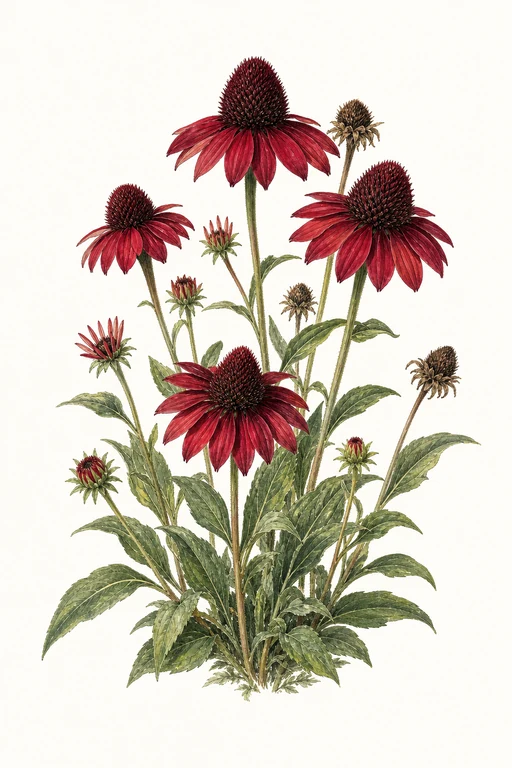
Cherry Brandy
90d to harvest
Velvety petals in rich cherry-brandy tones—glossy, warm, and unmistakably luminous—give Cherry Brandy Coneflower its signature presence in the garden. At maturity, the blooms form sturdy, upright cones with a softly layered, daisy-like flare, offering a satisfying texture that holds its shape through breezy summer days. Grow Cherry Brandy for long-lasting ornamental color in borders and cottage beds, where its bold, upright silhouette becomes a seasonal focal point from midseason onward.
Crop Dates
Growing note: Zone 1b has only 61 frost-free days — shorter than this crop's 90-day maturity. Outdoor planting is not viable; use protected cultivation.
| Milestone | Date |
|---|---|
| Last Frost | Jun 1st |
| Growing Approach | Protected Environment Only |
Crop Details
| Trait | Value |
|---|---|
| Days to Maturity | 90 |
| Sun Requirements | Full Sun |
| Growth Habit | Upright |
| Support Needed | None |
| Planting Depth | Normal |
| Germination Temp (°F) | 70 |
| Min Soil Temp (°F) | 60 |
| Min Night Temp (°F) | 50 |
| Harden Off (days) | 7 |
Recommended Companions
Frequently Asked Questions
What pest or disease commonly affects Rudbeckia hirta (Cherry Brandy), and how can I treat it?
Rudbeckia hirta is prone to powdery mildew, especially in humid conditions and dense foliage. Water at the soil line (not the leaves), thin plants for airflow, and remove heavily infected leaves early. If it keeps spreading, apply a labeled fungicide for powdery mildew on ornamentals and repeat as directed.
How do I know when Cherry Brandy is ready to harvest?
For Rudbeckia hirta, harvest when the flower heads are fully open and the petals are at their widest, usually around the 90-day mark from sowing. For cut flowers, clip blooms early in the morning and choose heads that are just beginning to show mature color at the center. If you’re harvesting seed, wait until the seed heads are dry and brown, and the fine seeds easily release when rubbed.