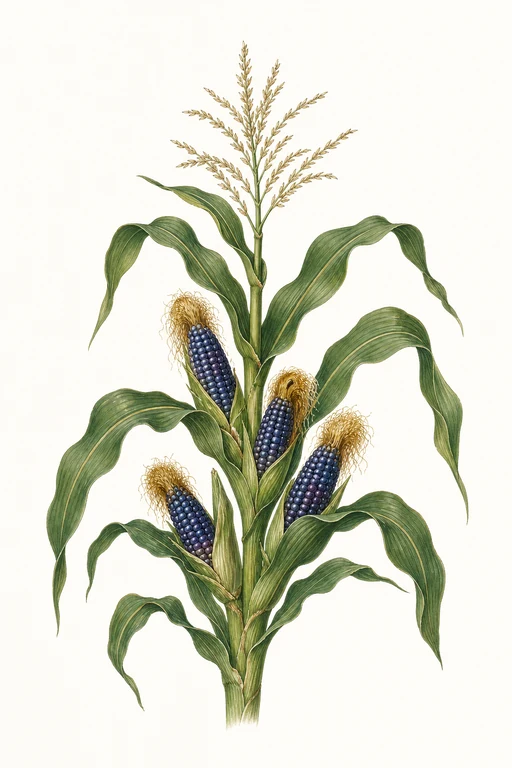
Miniature Blue
Corn
🌱 85d to harvest
Upright
Sweet, nutty kernels burst with a clean, tender snap—Miniature Blue delivers vivid, jewel-toned cobs that pop into delicate, fluf…
Crop Dates
| Milestone | Date |
|---|---|
| Start Indoors | Direct Sow |
| Last Frost | May 15th |
| Transplant / Sow Outdoors | May 15th |
| Harvest Begins | Aug 8th |
| Harvest Ends | Sep 1st |
Crop Details
| Trait | Value |
|---|---|
| Days to Maturity | 85 |
| Sun Requirements | Full Sun |
| Growth Habit | Upright |
| Support Needed | None |
| Planting Depth | Normal |
| Germination Temp (°F) | 60 |
| Min Soil Temp (°F) | 55 |
| Min Night Temp (°F) | 55 |
| Harden Off (days) | Not Required |
Recommended Companions
Frequently Asked Questions
What pest or disease is most likely on Zea mays var. saccharata (miniature blue sweet corn), and what should I do first?
Watch for corn earworm/cabbage looper and, on stressed plants, gray leaf spot. Inspect tassels and the ear silks twice weekly; if you see feeding near fresh silks, hand-remove affected tips and use an appropriate Bt (Bacillus thuringiensis) product targeted for caterpillars, applied at early silk-to-silk emergence. For gray leaf spot, remove the worst infected leaves early and keep foliage dry by watering at the base, since wet leaves spread the disease quickly in sweet corn.
How often should I water miniature blue sweet corn during the main growing phase (when it’s growing fast and starting to silk)?
During rapid vegetative growth and especially from tasseling through early milk, keep the soil consistently moist but not soggy—aim for about 1 to 1.5 inches (2.5–4 cm) of water per week, split into 2–3 deep waterings if it doesn’t rain. Check the top 2 inches of soil; if it’s drying out there, water again. Avoid soaking the bed right before harvest, which can encourage ear issues while still needing steady moisture to fill kernels properly.
How can I tell when miniature blue sweet corn is ready to harvest?
Harvest when the kernels turn from watery/clear to milky and the silk has browned—typically about 18–24 days after silking for sweet corn (Zea mays var. saccharata). To test, press a kernel with your thumbnail; a thin milky fluid means it’s at peak sweetness, while watery kernels are under-ripe and denting dough indicates it’s past prime. Pick the ears promptly once a few rows of kernels show milky streaks, then harvest frequently over the next couple of days as different ears mature at slightly different rates.