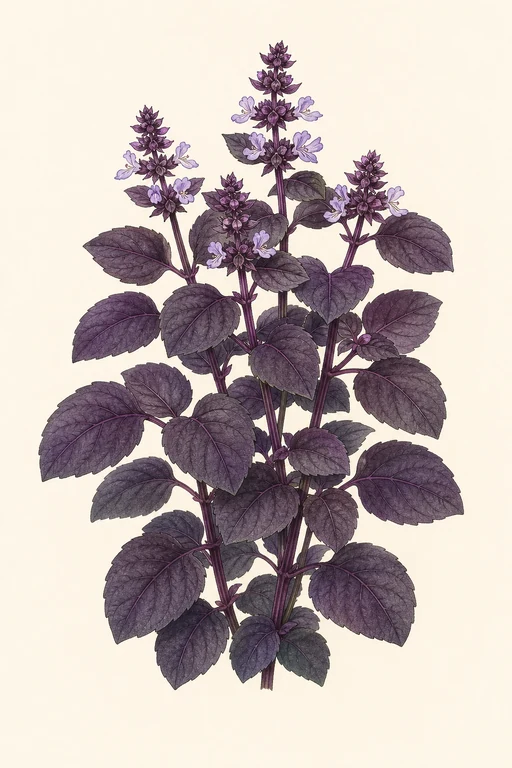
Amethyst Improved
Basil
🌱 70d to harvest
Upright
Slip your fingers through Amethyst Improved’s velvety, deep purple leaves and you’ll find a distinctly sweet, aromatic basil frag…
Crop Dates
| Milestone | Date |
|---|---|
| Start Indoors | Apr 8th |
| Last Frost | May 13th |
| Transplant / Sow Outdoors | Jul 1st |
| Harvest Begins | Sep 9th |
| Harvest Ends | Sep 27th |
Crop Details
| Trait | Value |
|---|---|
| Days to Maturity | 70 |
| Sun Requirements | Full Sun |
| Growth Habit | Upright |
| Support Needed | None |
| Planting Depth | Normal |
| Germination Temp (°F) | 75 |
| Min Soil Temp (°F) | 60 |
| Min Night Temp (°F) | 50 |
| Harden Off (days) | 10 |
Recommended Companions
Frequently Asked Questions
Why are my Amethyst Improved plants wilting and showing a gray, moldy stem/neck—what’s the likely problem and how do I stop it?
This is most often early blight or, more commonly, seedling/crown rot from excess moisture leading to fungal growth on the stem/neck. Remove and discard the worst affected plants, then water only at the soil line and avoid wetting leaves; improve airflow with wider spacing if plants are crowded. If the problem persists, apply a labeled fungal treatment suitable for eggplant/solanums and rotate away from the same bed to reduce reinfection.
How often should I water Amethyst Improved during the main growing phase, and how can I tell the soil is at the right moisture?
During the main growing phase (after plants are established and growing vigorously), water deeply about 1–2 times per week, aiming for evenly moist soil rather than frequent light watering. Check 2–3 inches down: water when it’s starting to dry at that depth, but don’t let the soil fully dry out or stay waterlogged. Consistent moisture is especially important once fruits begin to form to prevent blossom-end issues and bitter, stressed fruit.
How do I know when Amethyst Improved is ready to harvest?
Harvest when the eggplant fruits are fully colored (deep violet-purple) and firm, typically about 70 days from transplanting depending on your conditions. For best eating quality, pick at about 6–8 inches long (roughly 1/2 to 3/4 of the final size), because size increases quickly and overripe fruit can become seedy and less tender. Use scissors or a sharp knife and cut the stem just above the calyx to avoid tearing the plant.