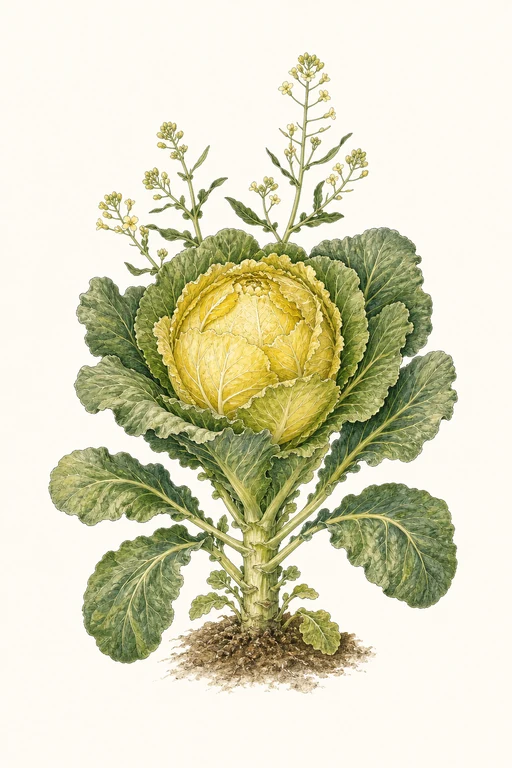
Golden Acre
Cabbage
🌱 70d to harvest
Rosette
Golden Acre cabbage brings a bright, buttery glow to the garden—crisp, sweet leaves with a tender bite and a finely layered head …
Crop Dates
| Milestone | Date |
|---|---|
| Start Indoors | Apr 10th |
| Last Frost | May 8th |
| Transplant / Sow Outdoors | May 1st |
| Harvest Begins | Jul 10th |
| Harvest Ends | Sep 30th |
Crop Details
| Trait | Value |
|---|---|
| Days to Maturity | 70 |
| Sun Requirements | Full Sun |
| Growth Habit | Rosette |
| Support Needed | None |
| Planting Depth | Normal |
| Germination Temp (°F) | 45 |
| Min Soil Temp (°F) | 40 |
| Min Night Temp (°F) | 30 |
| Harden Off (days) | 6 |
Recommended Companions
Frequently Asked Questions
What’s the most common Brassica pest or disease problem for cabbage (Brassica oleracea var. capitata) like ‘Golden Acre,’ and how can I control it?
Watch for cabbage worms (imported cabbageworm/loopers) and cabbage aphids, which cluster on new growth and leave ragged holes or sticky residue. Hand-pick worms early and use row cover over transplants to prevent egg laying; if infestations are heavy, apply an approved Bacillus thuringiensis (Bt) spray targeted to caterpillars following label directions. Also keep the plant base weed-free and avoid overhead watering to reduce foliar diseases like black rot and clubroot symptoms in stressed plants.
How often should I water Golden Acre cabbage during its main growing phase, and what soil moisture level should I aim for?
During active head formation (roughly weeks 5–10 after transplant, before maturity ~70 days), keep the soil evenly moist with about 1–1.5 inches (2.5–4 cm) of water per week total from rainfall plus irrigation. Water deeply so moisture reaches the root zone, then allow the top 1 inch of soil to dry slightly before watering again to prevent root stress and disease buildup. Mulch around the plants to stabilize moisture and reduce drought stress that can cause loose heads.
How do I tell when ‘Golden Acre’ cabbage is ready to harvest?
Harvest when the head is firm and compact, and the outer leaves are fully developed but still green; check by gently pressing the head—if it feels dense rather than springy, it’s ready. For a 70-day crop, start checking around day 65 and harvest once heads reach full size rather than waiting for color change alone. Cut the head with a sharp knife, leaving the outer wrapper leaves to protect the head during cool storage.