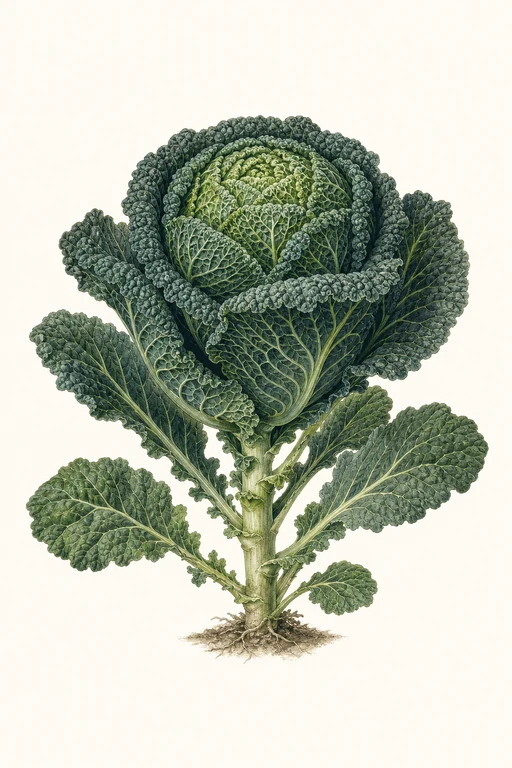
Savoy Perfection
Cabbage
🌱 85d to harvest
Rosette
Savoy Perfection unfurls in a dense, cathedral-like rosette of deeply crimped leaves, cool to the eye with a rich, blue-green glo…
Crop Dates
| Milestone | Date |
|---|---|
| Start Indoors | Apr 10th |
| Last Frost | May 8th |
| Transplant / Sow Outdoors | May 8th |
| Harvest Begins | Aug 1st |
| Harvest Ends | Sep 30th |
Crop Details
| Trait | Value |
|---|---|
| Days to Maturity | 85 |
| Sun Requirements | Full Sun |
| Growth Habit | Rosette |
| Support Needed | None |
| Planting Depth | Normal |
| Germination Temp (°F) | 75 |
| Min Soil Temp (°F) | 40 |
| Min Night Temp (°F) | 30 |
| Harden Off (days) | 6 |
Recommended Companions
Frequently Asked Questions
What pest or disease most commonly affects Savoy Perfection (Brassica oleracea var. capitata), and how do I control it?
Watch for cabbage worms (imported cabbageworm/diamondback moth larvae) that chew ragged holes in Savoy leaves. Hand-pick small larvae and use row cover once heads begin forming; if pressure is high, apply an insecticidal soap or Bacillus thuringiensis (Bt) and reapply as directed after new egg activity. Also monitor for black rot and clubroot—avoid contaminated soil, keep leaves dry, and don’t plant Brassicas in the same spot more than once every few years.
How often should I water Savoy Perfection during the main head-forming phase?
During the weeks when heads are enlarging (roughly mid-season to maturity), keep soil evenly moist but not waterlogged. In typical home gardens this often means watering 1–2 times per week, then adjusting to weather so the top few inches stay consistently damp; if leaves wilt in midday and spring back by evening, you’re slightly under-watering. Add mulch to slow drying because Savoy is slow to “close” a loose outer canopy and dries out unevenly if the soil surface is allowed to crust.
How can I tell when Savoy Perfection is ready to harvest?
Harvest at about 85 days when heads feel firm to the touch and the outer leaves are fully developed with good, tight savoy texture. Avoid waiting until heads split—check by gently pressing a few inches around the head; if the center yields like a thick ball, it’s ready, but if it’s still springy and loose, give it more time. For best quality, cut in the morning and leave 1–2 outer wrapper leaves to protect the head in storage.