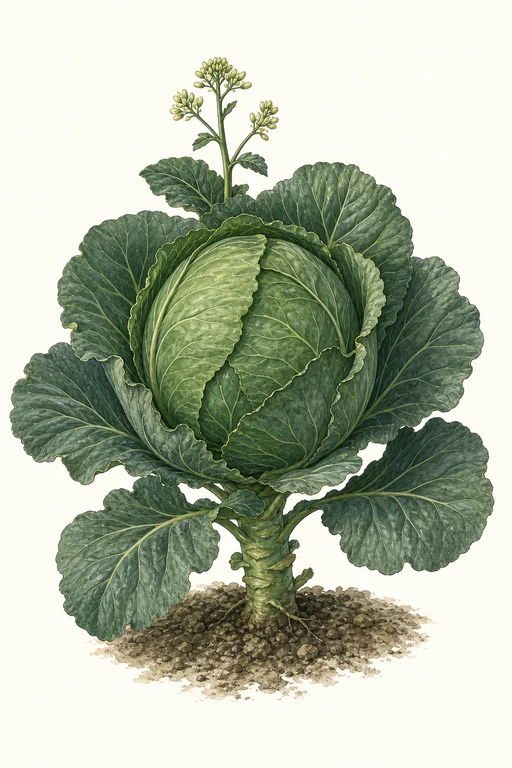
Stonehead
Cabbage
🌱 70d to harvest
Rosette
Crisp as fresh-cut glass, Stonehead cabbage forms a dense, tightly layered head with a cool, sweet bite and a clean, cabbage-forw…
Crop Dates
| Milestone | Date |
|---|---|
| Start Indoors | Apr 10th |
| Last Frost | May 8th |
| Transplant / Sow Outdoors | May 8th |
| Harvest Begins | Jul 17th |
| Harvest Ends | Sep 30th |
Crop Details
| Trait | Value |
|---|---|
| Days to Maturity | 70 |
| Sun Requirements | Full Sun |
| Growth Habit | Rosette |
| Support Needed | None |
| Planting Depth | Normal |
| Germination Temp (°F) | 45 |
| Min Soil Temp (°F) | 40 |
| Min Night Temp (°F) | 32 |
| Harden Off (days) | 6 |
Recommended Companions
Frequently Asked Questions
What pest or disease most commonly affects Brassica oleracea var. capitata (cabbage/“Stonehead”), and how do I treat it?
Cabbage can develop black rot and also suffer from cabbage worms (cabbage looper/diamondback moth). Remove and destroy infected leaves if you see yellowing that turns brown with blackened veins, and avoid planting in the same spot for at least 3 years. For worms, inspect undersides weekly and spray BT (Bacillus thuringiensis) or use a tight row cover so adults can’t lay eggs; repeat BT as label rates require after fresh egg hatchings.
How often should I water Stonehead during the main growing phase to keep heads forming well?
During head formation (roughly mid-season through maturity), keep the soil consistently evenly moist at about 1–1.5 inches of water per week, increasing slightly during hot spells. Water deeply rather than lightly so moisture reaches root depth, and don’t let the soil dry out completely between waterings—uneven moisture is a common trigger for poor head development and splitting.
How can I tell when Stonehead cabbage is ready to harvest at about 70 days?
Harvest when the head is firm to the touch and reaches its typical size, with leaves tightly wrapped and minimal give when you gently press the outside. Heads are usually ready around 70 days from transplant (or near that range from sowing depending on your schedule), and you should harvest before prolonged heat spikes or if leaves start to loosen. Use a sharp knife to cut the head at the base, and you can often leave the plant to see if side shoots develop for smaller follow-up harvests.