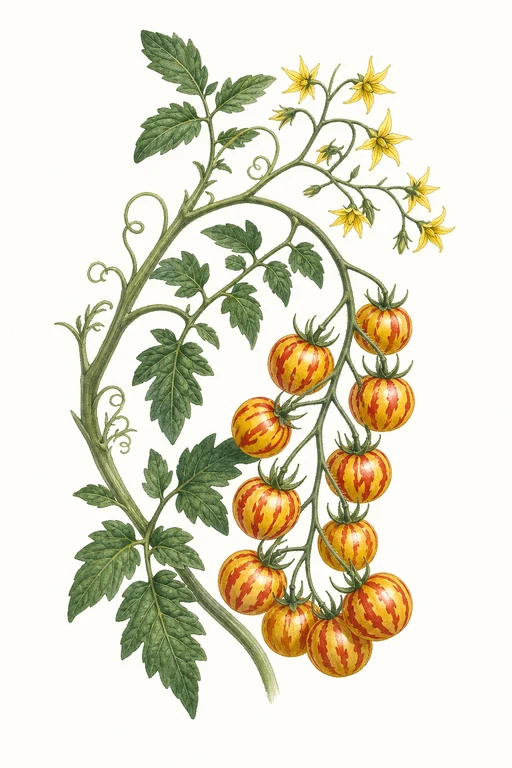
Zebra Cherry
Tomato
🌱 60d to harvest
Indeterminate
Sun-warmed and jewel-bright, Zebra Cherry tomatoes ripen in a mesmerizing pattern of creamy gold overlaid with bold, candy-stripe…
Crop Dates
| Milestone | Date |
|---|---|
| Start Indoors | Mar 20th |
| Last Frost | May 8th |
| Transplant / Sow Outdoors | Jul 3rd |
| Harvest Begins | Sep 1st |
| Harvest Ends | Sep 30th |
Crop Details
| Trait | Value |
|---|---|
| Days to Maturity | 60 |
| Sun Requirements | Full Sun |
| Growth Habit | Indeterminate |
| Support Needed | Stake |
| Planting Depth | Deep |
| Germination Temp (°F) | 75 |
| Min Soil Temp (°F) | 60 |
| Min Night Temp (°F) | 50 |
| Harden Off (days) | 10 |
Recommended Companions
Frequently Asked Questions
What pest or disease is most common on Solanum lycopersicum (Zebra Cherry tomatoes), and how should I manage it?
Watch for early blight (dark, concentric spots on older leaves) and start treatment as soon as spots appear. Remove and discard affected leaves, improve airflow with pruning and spacing, and apply a labeled fungicide for tomatoes if conditions are humid or spots spread. For prevention, water at the base so foliage stays dry and avoid working in the plants when leaves are wet.
How often should I water Zebra Cherry tomatoes during the main growing phase?
During fruit set and filling (around weeks 4–8 for a ~60-day crop), keep soil evenly moist with about 1–2 inches (2.5–5 cm) of water per week, adjusting for heat and container size. Water deeply when the top 1 inch (2–3 cm) of soil feels dry, then let excess drain—don’t keep the bed constantly wet. Inconsistent moisture is a common cause of blossom-end rot and fruit cracking, so aim for steady cycles.
How can I tell when Zebra Cherry tomatoes are ready to harvest?
Harvest when fruits reach full size and turn fully colored with their characteristic yellow-orange background and darker striping. Pick with a gentle twist and slight upward pull; the fruit should detach easily and feel slightly firm but yield to light pressure. For best flavor, harvest at peak ripeness (rather than leaving them to over-soften on the vine).