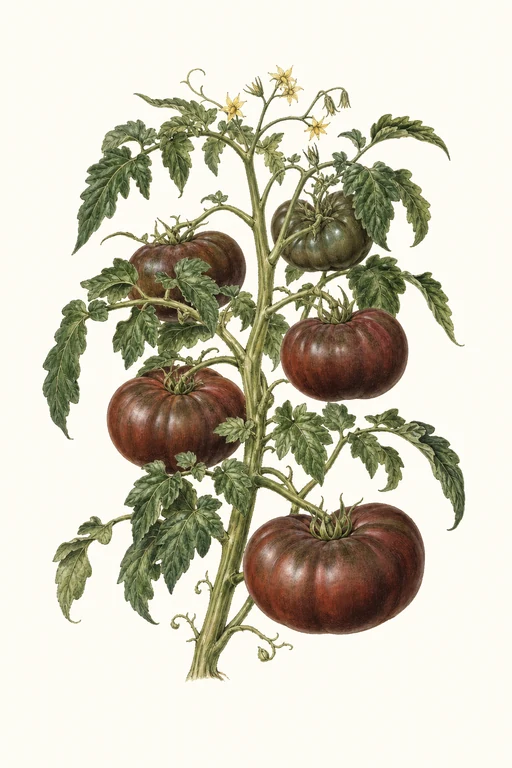
Black Krim
Tomato
🌱 85d to harvest
Indeterminate
Sink your spoon into the first glossy slice of Black Krim—its smoky, wine-dark flesh carries a rich, sweet-tang balance with a hi…
Crop Dates
| Milestone | Date |
|---|---|
| Start Indoors | Mar 16th |
| Last Frost | May 4th |
| Transplant / Sow Outdoors | Jun 29th |
| Harvest Begins | Sep 22nd |
| Harvest Ends | Oct 5th |
Crop Details
| Trait | Value |
|---|---|
| Days to Maturity | 85 |
| Sun Requirements | Full Sun |
| Growth Habit | Indeterminate |
| Support Needed | Cage |
| Planting Depth | Deep |
| Germination Temp (°F) | 75 |
| Min Soil Temp (°F) | 60 |
| Min Night Temp (°F) | 50 |
| Harden Off (days) | 8 |
Recommended Companions
Frequently Asked Questions
Why are my Black Krim tomato leaves turning yellow with dark spots, and what should I do?
Yellowing with dark, spreading leaf spots is often early blight or Septoria, which flares in warm, humid weather. Remove and discard the affected lower leaves, improve airflow by spacing plants, and water at the soil line (not on foliage). If it keeps progressing, spray an approved tomato fungicide and repeat according to the label, starting as soon as you see spots (before they reach the canopy).
How often should I water Black Krim tomatoes during the main growing phase (from flowering through fruit set)?
Water deeply about 2–3 times per week during flowering and fruit set, aiming for consistently moist (not soggy) soil. The target is even moisture: let the top 1 inch of soil dry slightly, then water until the root zone is soaked. Irregular watering can trigger cracking and blossom-end rot, so avoid quick, daily splashes and instead use slower, thorough watering.
How can I tell when Black Krim tomatoes are ready to harvest?
Harvest when the fruits are fully colored (deep red to mahogany with a pinkish marbling near the shoulders), and they yield slightly to gentle pressure. For Black Krim, wait until they’re not mostly green—at about 85 days you should see dependable ripening, but pick as soon as they feel ripe because flavor improves as they fully color. Avoid leaving them to over-ripen on the vine during hot, wet spells, which increases cracking and disease risk.