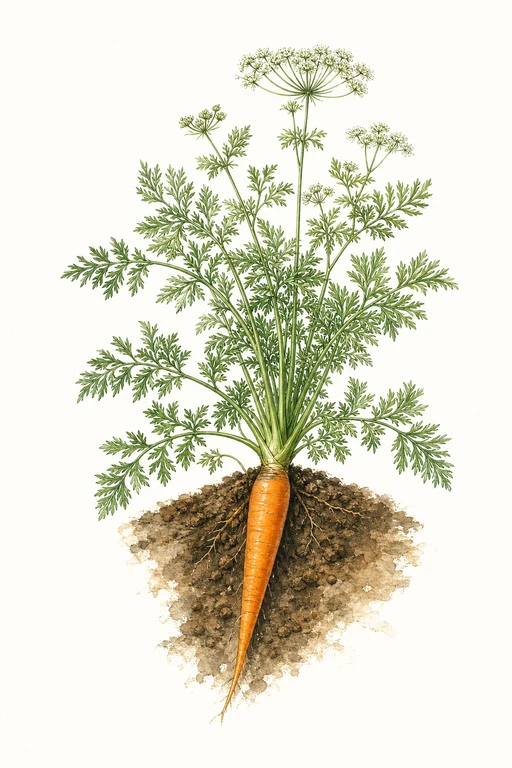
Flyaway
Carrot
🌱 78d to harvest
Rosette
Sweet, carrot-smooth flavor opens with a bright, honeyed snap—then settles into a tender, fine-grained bite that feels almost sil…
Crop Dates
| Milestone | Date |
|---|---|
| Start Indoors | Direct Sow |
| Last Frost | May 4th |
| Transplant / Sow Outdoors | May 4th |
| Harvest Begins | Jul 21st |
| Harvest Ends | Oct 5th |
Crop Details
| Trait | Value |
|---|---|
| Days to Maturity | 78 |
| Sun Requirements | Full Sun |
| Growth Habit | Rosette |
| Support Needed | None |
| Planting Depth | Normal |
| Germination Temp (°F) | 75 |
| Min Soil Temp (°F) | 50 |
| Min Night Temp (°F) | 28 |
| Harden Off (days) | Not Required |
Recommended Companions
Frequently Asked Questions
What pest or disease most commonly affects carrots (Daucus carota var. sativus), and what can I do about it?
Carrot root flies and early “damping-off” can be major issues, especially in cool, wet sowing beds. Cover seedlings with a fine insect net or row cover to block carrot root flies, and avoid overwatering so the soil stays evenly moist but not soggy to reduce damping-off. If seedlings collapse, remove affected plants and re-sow into fresh, well-drained soil rather than keeping the same bed wet.
How often should I water during the main growing phase of carrots, and how do I keep the soil at the right moisture level?
During active root growth (roughly mid-season through about 2–3 weeks before harvest), water deeply about 1–2 times per week to keep the top 6–8 in (15–20 cm) consistently moist. Aim for a damp, crumbly soil—not dry-cracking and not waterlogged—because irregular moisture leads to forked, split, or misshapen roots. If rains are light, check moisture by feel: the soil should be moist a finger’s depth down, not dusty or muddy.
How can I tell when carrots (Daucus carota var. sativus) are ready to harvest?
Start checking around your stated maturity window (about 78 days from sowing), and harvest when the roots are thick enough for the size you want. A good sign is the “shoulder” of the root bulging at the soil surface and reaching the typical diameter for your variety; if you see a lot of taper, it’s still underfilled. Pull one as a test—if the core is firm and not woody, you’re ready to harvest; if it’s very small and thin, wait about a week and re-check.