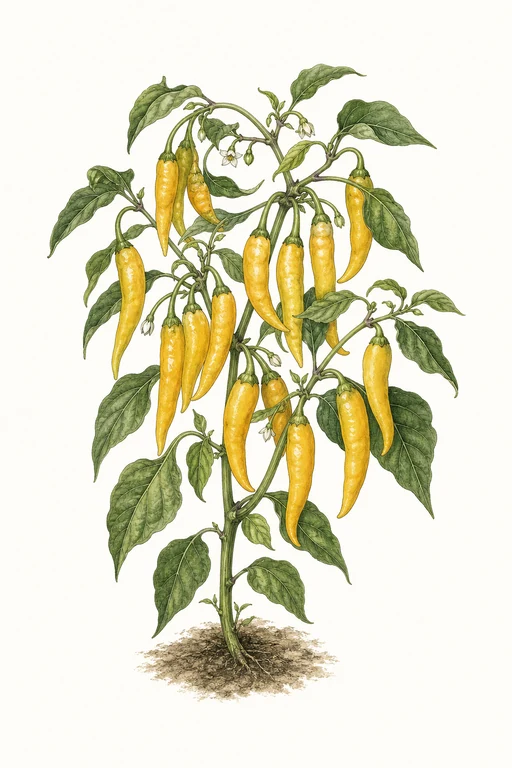
Hungarian Hot Wax
Pepper
🌱 75d to harvest
Upright
Hungarian Hot Wax peppers arrive with a luminous, honeyed glow—crisp, waxy pods that start warm butter-yellow and ripen to a deep…
Crop Dates
| Milestone | Date |
|---|---|
| Start Indoors | Mar 16th |
| Last Frost | May 4th |
| Transplant / Sow Outdoors | Jun 29th |
| Harvest Begins | Sep 12th |
| Harvest Ends | Oct 5th |
Crop Details
| Trait | Value |
|---|---|
| Days to Maturity | 75 |
| Sun Requirements | Full Sun |
| Growth Habit | Upright |
| Support Needed | Stake |
| Planting Depth | Normal |
| Germination Temp (°F) | 80 |
| Min Soil Temp (°F) | 60 |
| Min Night Temp (°F) | 50 |
| Harden Off (days) | 10 |
Recommended Companions
Frequently Asked Questions
What pest or disease most often affects Capsicum annuum (Hungarian Hot Wax), and how do I treat it?
Watch for aphids and spider mites, which commonly attack hot peppers under warm, dry conditions and cause distorted, curled growth. Spray foliage with insecticidal soap (especially underside leaf surfaces) and repeat every 5–7 days for 2–3 rounds; for heavy outbreaks, use a targeted miticide/soap program as labeled. Also keep an eye out for blossom-end rot (black, sunken pepper bottoms), which is usually from inconsistent watering—water evenly and mulch to stabilize moisture.
How often should I water Hungarian Hot Wax during the main growing phase?
During flowering and fruiting, keep the soil evenly moist but not soggy—aim for about 1–2 inches of water per week, adjusted for heat and container size. Water deeply when the top 1 inch of soil feels dry, and avoid letting the soil swing from wet to dry because peppers set poorly and can develop blossom-end rot. In-ground, a 2–3 inch mulch layer helps maintain steady moisture around the roots.
How can I tell when Hungarian Hot Wax peppers are ready to harvest?
Hungarian Hot Wax peppers are typically ready around 70–80 days after transplanting or near the 75-day maturity window, but color is your best indicator. Harvest when pods are firm and have reached the mature color (often green to yellow-orange depending on your target), and cut with scissors or pruners to avoid damaging the plant. If left longer, they may continue ripening and becoming hotter and more deeply colored.