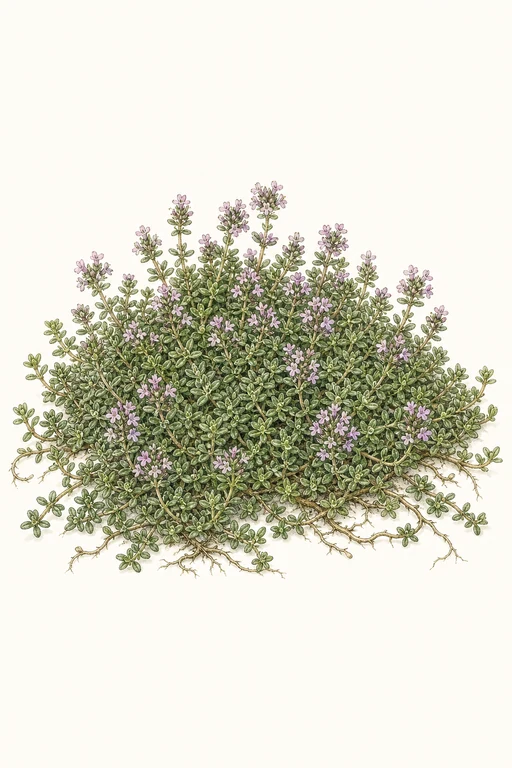
Thymus Minus
60d to harvest
Aromatic as a sunlit hillside—Thymus Minus releases a vivid, thyme-forward fragrance with every brush of foliage, carrying a warm, herbal lift that lingers in the garden air. This creeping thyme forms a dense, low mat of tiny leaves with a fine, velvety texture, ideal for edging and filling in bare ground while staying pleasantly compact. Grow it for its intense scent and its enduring presence—an herbaceous perennial that rewards close attention year after year.
Crop Dates
| Milestone | Date |
|---|---|
| Start Indoors | Direct Sow |
| Last Frost | Apr 10th |
| Transplant / Sow Outdoors | Apr 10th |
| Harvest Begins | Jun 9th |
| Harvest Ends | Oct 28th |
Crop Details
| Trait | Value |
|---|---|
| Days to Maturity | 60 |
| Sun Requirements | Full Sun |
| Growth Habit | Perennial_Crown |
| Support Needed | None |
| Planting Depth | Surface |
| Germination Temp (°F) | 60 |
| Min Soil Temp (°F) | 50 |
| Min Night Temp (°F) | 35 |
| Harden Off (days) | Not Required |
Recommended Companions
Frequently Asked Questions
What pest or disease commonly affects Thymus serpyllum (creeping thyme), and how can I fix it?
Creeping thyme (Thymus serpyllum, Lamiaceae) most often suffers from root rot when the soil stays wet—look for sudden wilting, yellowing, and stems that pull away easily. Improve drainage immediately, water only when the top 1–2 cm of soil is dry, and remove any collapsed plants to prevent spread; thinning overcrowded patches also improves airflow around the foliage.
How often should I water Thymus serpyllum during active growth?
During the main growing phase, water deeply only when the surface has dried—typically about once every 7–10 days in summer if there’s no rain, but less often in cool or humid weather. Aim for evenly moist soil at rooting depth early on, then shift to drier conditions to keep this thyme’s shallow root system healthy and prevent rot.
How do I know when Thymus serpyllum is ready to harvest?
Harvest around 60 days after germination when the plants have filled in and produce strong, fragrant foliage; for best flavor, cut just before the small flowers fully open. Snip stems with sharp scissors in the morning, and don’t remove more than about one-third of the top growth at a time so the patch can regrow for additional cuts.