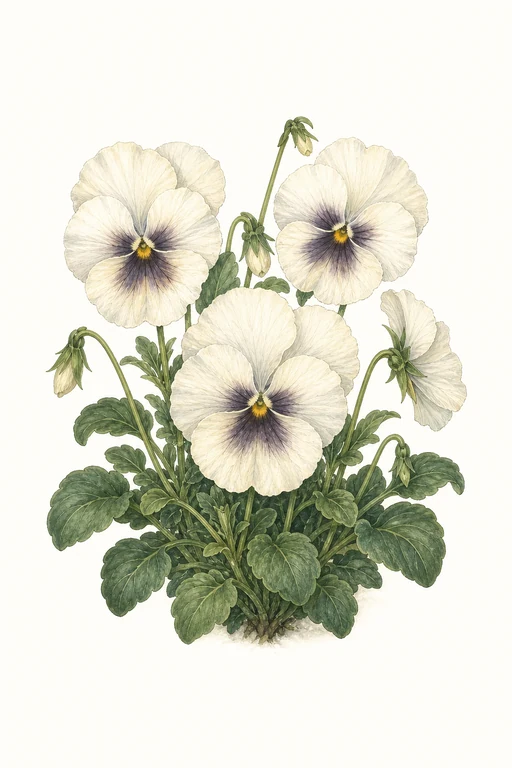
Atlas Angel
Pansy
🌱 70d to harvest
Rosette
Velvety blooms arrive in a painterly spectrum, with Atlas Angel’s signature face—soft, luminous petals washed in pale angelic ton…
Crop Dates
| Milestone | Date |
|---|---|
| Start Indoors | Jan 12th |
| Last Frost | Mar 23rd |
| Transplant / Sow Outdoors | Mar 16th |
| Harvest Begins | May 25th |
| Harvest Ends | Nov 12th |
Crop Details
| Trait | Value |
|---|---|
| Days to Maturity | 70 |
| Sun Requirements | Full Sun |
| Growth Habit | Rosette |
| Support Needed | None |
| Planting Depth | Normal |
| Germination Temp (°F) | 65 |
| Min Soil Temp (°F) | 40 |
| Min Night Temp (°F) | 28 |
| Harden Off (days) | 7 |
Recommended Companions
Frequently Asked Questions
What pest or disease most commonly affects Viola × wittrockiana (Atlas Angel), and how can I treat it?
Violas commonly develop gray mold (Botrytis) and leaf spotting, especially when foliage stays wet and air flow is poor. Remove affected leaves, water at the soil line, and increase spacing/airflow; for persistent spots or fuzzy gray growth, use a labeled fungicide for ornamentals and repeat as directed. Also avoid overcrowding because Viola × wittrockiana is prone to rapid spread when plants are dense.
How often should I water Atlas Angel pansies during the main growing phase?
During active growth (roughly until mid-bloom), keep the soil evenly moist but not soggy—aim for consistently damp soil at the 1–2 in (2–5 cm) depth. In warm full-sun conditions, this often means watering about 1–2 times per week, increasing to every 2–3 days during hot spells; water deeply, then let the top layer begin to dry before watering again. Poor drainage or staying wet between waterings increases the chance of fungal issues.
How do I know when Viola × wittrockiana ‘Atlas Angel’ is ready to harvest (for flowers/leaves)?
If you’re harvesting flowers, start picking when buds are fully formed and the first petals are open—this is typically within about 70 days from sowing under good conditions. Harvest in the morning and choose blooms with strong color and firm petals; remove spent flowers (“deadhead”) to encourage continuous blooming. For leaf harvest, take only a light pinch of outer leaves once plants are well established (with multiple healthy leaves), avoiding removing too much at once.