Tianjin Green
Celery
🌱 80d to harvest
Rosette
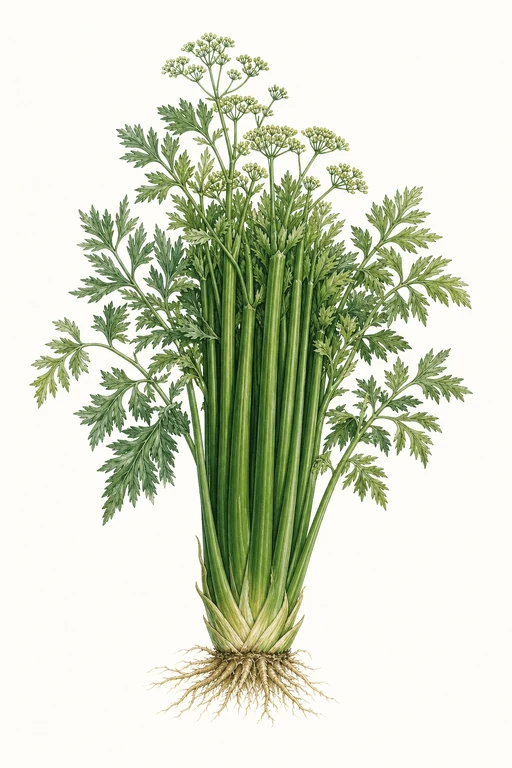
Crisp and cool from the first bite—Tianjin Green celery forms dense, upright stalks with a clean, bright snap and a distinctly sw…
Crop Dates
| Milestone | Date |
|---|---|
| Start Indoors | Jan 12th |
| Last Frost | Mar 23rd |
| Transplant / Sow Outdoors | Mar 16th |
| Harvest Begins | Jun 4th |
| Harvest Ends | Nov 12th |
Crop Details
| Trait | Value |
|---|---|
| Days to Maturity | 80 |
| Sun Requirements | Part Sun |
| Growth Habit | Rosette |
| Support Needed | None |
| Planting Depth | Normal |
| Germination Temp (°F) | 70 |
| Min Soil Temp (°F) | 45 |
| Min Night Temp (°F) | 35 |
| Harden Off (days) | 7 |
Recommended Companions
Frequently Asked Questions
What pest or disease problem commonly affects Apium graveolens (self-blanching celery) like Tianjin Green, and how do I treat it?
Celery commonly suffers from early blight/leaf spot–type problems and, in wet weather, bacterial or fungal leaf lesions that show up as spots or yellowing on stems and leaves. Remove the worst leaves immediately, improve airflow around the plants, and water at the soil line rather than over the foliage. If spots keep spreading, apply a labeled fungicide for edible celery/leafy Apiaceae and repeat according to the label after rain or heavy dew.
How often should I water Tianjin Green celery during the main growing phase?
During the bulk of growth (after establishment through about day 60), keep soil evenly moist but not waterlogged—celery (Apium graveolens) is sensitive to drought stress and will get stringy or bitter if it dries out. In most home gardens, this is about 1–2 inches of water per week, split into 2–3 waterings during hot spells. Check the top 1 inch of soil: water when it starts to dry there, and avoid letting it fully dry out.
How can I tell when Tianjin Green self-blanching celery is ready to harvest?
Harvest at about 80 days when the plants are firm, well-developed, and the stalks have reached full size with tight, upright growth. For self-blanching types, blanching happens as growth progresses, so focus on stalk maturity—cut stalks at the base once they feel sturdy rather than hollow or loose. If you can see smaller, thinner outer stalks, you can harvest in stages, but aim to take the main crop when most stalks have bulk.